Was there really a connection between Saddam Hussein and Al Qaeda?
Though I have my doubts, I'm certainly not in a position to be definitive with an answer. However, This book, by Stephen F. Hayes of the Weekly Standard, argues that there was.
Given the book's premise, the polarized 1-star/5-star reviews on its Amazon page are hardly surprising, and, I would argue, don't really provide much information about book's content. There is, however, a ready guide available for understanding its real value--one that I've touched on in another context before--its used price: 1 cent.
This ranks The Connection alongside such classics as Bankruptcy, 1995, and Unfit For Command.
Viva la Price System!
Sunday, March 25, 2007
The Market is Smarter Than You

Wednesday, March 07, 2007
Six Seconds That Changed The World
Via Against Monopoly and many thanks to Jim Lippard for bringing it to my attention.
This video details the unlikely history and sad implications behind an extremely influential B-side drum break from 1969.
Enjoy!
Sunday, February 25, 2007
Why Own When You Can Rent?
You see the ads everywhere, and the idea seems at the core of American culture. Talk to any Realtor and you’re bound to get a half dozen reasons why owning is better than renting. The Searchlight Crusade has a whole series of persuasive articles arguing that now is the best time to buy in San Diego. Implicit in his analysis is an estimate of future appreciation rates, which are anybody’s guess.
I used to own 4 houses. My parents have been part-time real estate investors since I was a young kid. I guess, at bottom, I buy into all this “buy versus rent” crap, myself, as I’ve recently been seriously thinking of buying something—anything—so that I’m not just “throwing my money away.”
But, really, is it true that owning is always and everywhere better than renting? It seems a foregone conclusion that buying a home in Phoenix in 2000 was a good idea (though at the time, of course, things were far from clear-cut). What about now? Sadly, certain knowledge about the future is impossible. Nonetheless, it seems unlikely that the price trends of the past 6 years are going to continue unabated.
There is, however, another way to look at the problem—one that doesn’t require gazing into crystal balls or reading tea leaves. It’s a “back of the envelope” technique that you’re also not likely to learn from your typical Realtor or real estate guru, either, even though it can tell you quickly and unequivocally whether a given property is a “good deal” or not.
In a nutshell, the idea is to take a property you are interested in and compare the monthly cost of renting it with the monthly cost of owning it at 80% LTV. If it’s cheaper to rent it then the house is overpriced. If it’s cheaper to own it, then buy it!
Let’s take a look at some actual Phoenix area properties and see what we find.
Here is a home in Avondale renting for $1,150/month. A substantially similar home down the street sold in January for $255,000. Monthly housing costs as an owner for this home, then, would be $1,583 ($1,263.00 principle and interest payments on a $204,000 loan at 6.3%, plus $55 HOA fees, plus $70, plus $195 taxes).
In other words, if you were to put 20% down on a house in that neighborhood with the intent to rent it out, you’d be subsidizing your renter to the tune of almost $5,200/year—and that’s before any expenses.
One hopes that the owner of the actual rental isn’t faced with such a situation. However, what can be said with certainty is that their return on equity is unacceptably low—unless the property’s value is appreciating a lot faster than $5,200 yearly. This was the case the last few years, but who can say it will continue that way much longer?
Here is a condo in Phoenix renting for $1,190/month that would cost you $1,462/month ($1,219 monthly payments on a $197,000 loan at 6.3%, plus $135 HOA, plus $108 taxes) to own. Were you maybe wondering why there were so many condo conversions recently? There’s your answer. What apartment building owner wants to lose $272/month on every unit they own? What could you do with an extra $3,300 a year?
Suzette wants to “make a deal” on a lease-to-own condo in Chandler—with a current asking price of $264,000. Let’s be generous and assume a market rent of $1,300/month. In that case, any “deal” that involved paying more than $220,750 would be a bad one (unless you’re Suzette, I mean).
Here is a 3 bedroom house in Scottsdale you can rent for $1950/month today. To buy it today, on the other hand, would cost you $2,602 a month ($2,352 principle and interest payment on a $380,000 loan at 6.3%, plus $100 insurance and $150 taxes). Whoever ends up renting that place should kiss their landlord’s feet, as they are basically being given a $7800/year gift.
What can we take away from this analysis? First off, I think it’s fairly clear that pretty much no one in Phoenix is making money as a landlord right now (I mean to say: specifically when calculating a return on equity). Secondly, people who say it’s a “buyer’s market” don’t know what they’re talking about. Thirdly, something’s gotta give! There’s no way real estate investors are going to continue to lose money hand over fist over the long term. Either housing prices have got to come down or rents have to go up. I imagine that the future is going to see some combination of those two things.
Meanwhile, I’m gonna keep renting—and putting the money I’ll be saving into something likely to provide a much higher return.
Wednesday, February 14, 2007
Love and Marriage Redux
I have decided to readdress the marriage issue a second time, partially because I failed to mention the Alternatives to Marriage Project in the prior post, but also because, to my dismay, no one aside from Jim even attempted to answer directly any of the many questions I asked (and Jim's answer was a weak one, in my opinion). I can only guess that my questions were all misconstrued as rhetorical. So, this time I think I'll use more direct language, which will hopefully encourage a more fruitful discussion.
Marriage is, at best, meaningless. At worst, marriage is a superstition on a par with a belief in wood sprites. Marriage and commitment (...and love ...and cuddling ...and financial support ...and sex, etc.) are not identical, and I believe that people who conflate these things are making a category mistake. Contrary to Jim's assertion, people's primary motivations for marriage don't include avoiding getting hassled by hospital staffs (or I should say this is true at least for the vast majority of people who aren't robots).
On Valentine's Day, Howard Stern announced his engagement to Beth Ostrowsky, his sweetheart of more than 6 years. He received dozens of congratulatory phone calls about the engagement. I truly do not understand why (and, by the way, none of the people congratulating him brought up tax savings or avoiding hassles in hospitals). How will marriage improve their relationship? (By the way, that is not a rhetorical question). Is Howard, perhaps, afraid that without the marriage contract, BethO might leave him? Is perhaps fear the primary reason for marriage, then?
At one point Howard made the odd statement that by getting married he was "giving up other pussy." How is that? Hadn't he already done that six years earlier? I honestly do not understand this--unless, in truth, marriage consists primarily in making the statement, "I promise to give you half of my assets, plus additional future income, if I ever have sex with someone other than you, or even if I decide at some later date that I no longer want to be with you."
Do people really find that to be a romantic sentiment?
(Non-religious) people who want to defend marriage need to explain:
1) Why forcing someone to stay with you past the point they would in the absence of a marriage contract should ever be considered a good thing. Why would that situation ever be preferable to one where it's clear that the couple is together out of love and shared values?
2) Exactly what it is that marriage gives you that you absolutely cannot get outside of marriage.
3) Why those few legal rights marriage conveys to a couple are so damned important - and yet no one ever mentions them, really, when they talk about marriage.
Sunday, February 04, 2007
Love and Marriage

Why do we have marriage contracts, but not friendship contracts?
Why is asking someone to marry you any different than what Calvin is asking Hobbes in the above cartoon?
I confess to not understanding marriage’s allure. Some might conclude from this that I must not be much of a romantic. However, I would counter that perhaps my misunderstanding is due to a genuine romanticism on my part. After all, what is the defining characteristic of “marriage”? It’s not love. It’s not commitment. Love and commitment are beautiful, romantic things to be cherished and encouraged—and even celebrated and announced publicly to friends and family—but these things are not the same as marriage.
Marriage—stripped of its religious aspects, which, as an atheist, I of course find utterly meaningless—is simply a contract, isn’t it? And not just any contract. It’s a contract designed to make it difficult and expensive for one party to leave the other. Why would anyone do that—especially to someone they love? How is binding someone to you, even if only figuratively, in any way romantic? Why create a situation in which there is any doubt about the motivations behind your spouse’s (for lack of a better word) sticking by you?
Thoughts on this issue are encouraged and appreciated. You can find more food for thought in this essay written by the egoist John Beverley Robinson in 1889.
Why is asking someone to marry you any different than what Calvin is asking Hobbes in the above cartoon?
I confess to not understanding marriage’s allure. Some might conclude from this that I must not be much of a romantic. However, I would counter that perhaps my misunderstanding is due to a genuine romanticism on my part. After all, what is the defining characteristic of “marriage”? It’s not love. It’s not commitment. Love and commitment are beautiful, romantic things to be cherished and encouraged—and even celebrated and announced publicly to friends and family—but these things are not the same as marriage.
Marriage—stripped of its religious aspects, which, as an atheist, I of course find utterly meaningless—is simply a contract, isn’t it? And not just any contract. It’s a contract designed to make it difficult and expensive for one party to leave the other. Why would anyone do that—especially to someone they love? How is binding someone to you, even if only figuratively, in any way romantic? Why create a situation in which there is any doubt about the motivations behind your spouse’s (for lack of a better word) sticking by you?
Thoughts on this issue are encouraged and appreciated. You can find more food for thought in this essay written by the egoist John Beverley Robinson in 1889.
Thursday, January 25, 2007
Publish or Profit?
Whenever someone tells you that he or she knows how to beat the market consistently, please feel free to raise an incredulous eyebrow. When that person follows up such a claim with an offer to show you how to do it... for a fee, make sure you've still got your wallet as you move a safe distance away.
The reason why is a concept I have touched on before: competitive markets are very efficient at driving down "abnormal" profits.
The Unknown Professor agrees with me on this, and in this post he points out an interesting recent paper that is yet more evidence for the validity of the efficient markets hypothesis.
Colby Wright, the paper's author, wondered why a financial economics researcher who thinks he's found a legitimate exploitable anomaly would tell anyone about his discovery instead of simply keeping the information to himself and taking full advantage of the profit opportunity. Wright hypothesized that researchers without established track records and with fewer published papers would be more likely to write about market anomalies than those researchers with strong reputations and long publishing careers, because writing about an anomaly would help a newer researcher establish their reputation (and the veteran researcher would rather keep the opportunity to himself). The evidence, according to Wright, bears this out.
For more detail, see the post at Financial Rounds, or read the original paper.
Saturday, January 20, 2007
Rowing Stats
These are my current best rows for the Concept 2 indoor rower 2007 season. The rankings are as of today and will definitely change (and I will, hopefully, clock some better rows between now and the end of May). If you're lucky enough to have a Concept 2 rower and the absolutely awesome RowPro software for it, you can download my ranking rows from the Concept 2 ranking lists. Great Fun!
| Time | Standing | Date | ||
|---|---|---|---|---|
| 2000M | 07:30.1 | 613 of 1125 54% | 1/7/2007 | |
| 5000M | 19:15.2 | 439 of 1164 38% | 1/8/2007 | |
| 6000M | 23:41.5 | 168 of 345 49% | 5/14/2006 | |
| 7445M | 30:00.0 | 406 of 891 46% | 1/3/2007 | |
| 10000M | 41:52.3 | 561 of 872 64% | 12/24/2006 |
Thursday, January 04, 2007
Help!
Can anybody give me some pointers on how to fix the header code of my blog so that my Earthrise image is not obscured by that green block?
Thanks.
Tuesday, January 02, 2007
What does God explain?
When guys like Will Wilkinson are writing brilliant stuff like this it really kills my desire to blog much at all, at least when it comes to the heavy philosophical topics. Given the law of comparative advantage, I should leave the philosophizing to Will (and others) and I'll stick to, uh..., something else I haven't quite figured out, yet.
Anyway, I particularly like Will's approach to the definition of an atheist, here:
...[I]f something plays a role in our best explanation of some phenomenon, you should believe it exists. Otherwise, not. God, for instance, is the best explanation for nothing. That’s why you shouldn’t believe in God, or the posits of string theory. (People...who hesitate to call themselves atheists because they cannot “prove” nonexistence are simply confused about ontological commitment. If [one's estimate of the probability] p for “God exists” is so low (”vanishingly unlikely”), then God must play no role in [one's] economy of explanation, which is all there is to being an atheist. You don’t just get to decide whether or not you are one.)I see little to disagree with in any of the rest of the post, either (or the whole blog, for that matter).
I rarely find myself feeling envious of another man's genius, but Will Wilkinson is definitely one of the few exceptions. Perhaps in part it's because he's got a really hot girlfriend who seemed (at last check, anyway) to be totally nuts about him. Some guys have all the luck!
Saturday, December 23, 2006
I Caught a Virus
I tend to be a party pooper and not participate in these things, but the complete absurdity and randomness of this blogging virus amused me. I'm always a sucker for the non sequitur. Plus, it's not like I've been flush with topics to write about, lately, so here goes...
Dikkii has tagged me with the following task:
- Grab the nearest book...
- Name the book and the author...
Title: Environmental Gore: A Constructive Response to Earth in the Balance
Editor: John A. Baden
Author of the page in question: Richard S. Lindzen
Year book published: 1994
- Turn to page 123...
- Go to the fifth sentence on the page...
- Copy out the next three sentences and post to your blog...
Moreover, according to many studies by economists, agronomists, and hydrologists, there would be little difficulty adapting to such warming if it were to occur. Many aspects of the "catastrophe" scenario have already been largely discounted by the scientific community. For example, fears of massive sea level increases accompanied many of the early discussions of global warming, but these estimates have been steadily reduced by orders of magnitude, and now it is widely agreed that even the potential contribution of warming to sea level rise would be swamped by other more important factors.- Tag three more folks...
Jim Lippard
Steve
Akuwa
I won't take it personally if any of you decide not to pick up the baton.
Friday, December 22, 2006
How People Die
The other day I was randomly wondering how many people die every year from slipping in the shower. Figuring that the answer must be available on the internet somewhere I went in search. Well, I didn’t find exactly what I was looking for, but thanks to the NCHS (.pdf) I found a bunch of equally interesting stuff.
The number one killer of the 2,442,923 Americans who died in 2003 was cardiovascular disease, which took 901,753 souls. Cancer was a distant second, at 554,643. Diabetes killed another 73,965. Those numbers, I think, are indicative of our aging population. Young people don’t generally die from those diseases, and when you’re old the likelihood that your death will be due to something else is pretty low.
In 2003, 44,059 people were killed by motor vehicles - 26,963 more than the 17,096 people who were murdered (67.8% of which - 11,599 - were killed by guns). I think the number of gun homicides is interesting in light of the number of people killed by accidental falls (all falls, not just falls in the shower) - 16,926.
And who knew that 2,766 people died from complications in surgery? Yikes!
Friday, December 15, 2006
A Steep Cliff
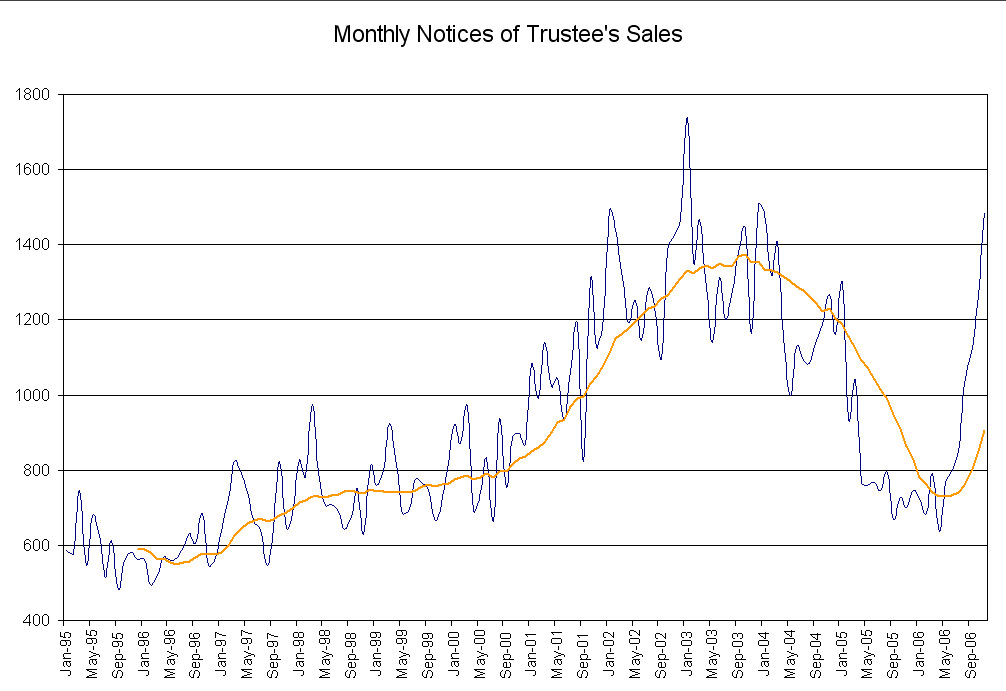
Normally I would post this sort of stuff up over at The Lippard Blog, but Jim's got it converted over to Blogger Beta and consequently I can't access it any longer.
I've been tracking Maricopa County's Notices of Trustee Sales for the past few months. As you can see, during that time the number has been climbing precipitously, and in an unprecendented fashion.
November's count was 1486.
It would seem, now, that the question is no longer "Is there a housing bubble?", but "How big is the pop going to be?"
Sunday, December 03, 2006
No More Static Beats???
Static Beats has terminated its webcast indefinitely. This is sad news, though not entirely unexpected, given that the webcast was free and the site itself didn't seem to have any real means of revenue generation.
The site's owner has sort of feebly suggested charging a monthly subscription, which I'd probably go for, but it's not clear if the webcast would still be free for everyone, whether you subscribe or not. That does seem to be what they are proposing, though, which may go a long way toward explaining why they've only had 4 volunteers so far. In economics this situation is known as the "free rider problem." If you can get something while having someone else pay for it then why pay for it yourself?
Another possible solution might be for Static Beats to charge artists for inclusion in the webcast. It is an effective advertising method for them. I would never have heard of Bluetech, MD, Modeselektor, Automat, etc., without the webcast, after all. On the other hand, this will result in the webcast's content being determined by commercial considerations instead of the tastes and whims of Shimone/Justes, effectively eliminating its appeal in the process. Not good.
Anyway, I hope it all gets worked out somehow. I'm lost without my static beats!
The Sleeper Has Awakened
So.
Obviously this blog has been dormant a while. My excuse is roughly equal parts of overworking, lack of time, and lack of things I want to say. Throw in an appreciable amount of laziness and you've got yourself a deadly combination.
However, I am back. I managed to leave my shitty job in Virginia and move back to Arizona with only one unfortunate $1000 stopover in Amarillo, TX, to replace my car's MAF sensor, fuel pump, and fuel filter.
Now I am once again gainfully employed - this time at a job that has no overtime and will actually allow me to take every other Friday off! As Borat would say, "Nice!" Plus, I'm living in a nice apartment, not a kitchenless basement "apartment."
Things are looking up. Look for more activity on Die Eigenheit in the near future. For now, it looks like I have several new(ish) comments to respond to.
Sunday, September 24, 2006
Oh, the Irony!
I want nothing more than to leave my current job and return to Phoenix. Unfortunately the job market in Phoenix seems not to be doing so well, at least as measured by the sad trickle of new jobs appearing in my various key-word searching RSS aggregators. I'm lucky if I send my resume out more than twice a week, lately. I recently put my father's Mesa address and phone number on my resume, which has at least significantly improved response percentages. Still, given the situation I am seriously considering taking any remotely relevant job, even one that pays significantly less than I'm making now.
Meanwhile my current employers recently offered me a promotion. I told them I'd think about it. Then I did some research as to what the local market rate is for the position and discovered that in spite of a recent $18K jump in salary they'd have to pay me an additional $15K/year to bring me up to "average" - and in fact my current salary is below the bottom of the ranges provided by Payscale.com and Salary.com! Since my employers hadn't actually specified a number in the informal offer I sent an email detailing my findings and suggesting that providing a formal offer and naming an actual amount might help me with my decision.
The funny thing is that if they do agree to compensate me at market rate then I think I'll be disappointed, because it will make it a lot harder to feel good about moving back to Phoenix and taking a lower-paying job.
Saturday, September 09, 2006
Former Burleyist – Joe Arlt
On September 3rd this blog received a visit from an anonymous commenter who claimed to be Joe Arlt. Arlt is the author of the tape set Wrap Your Way to Wealth, and he was once, arguably, the world’s premier Burleyist. Based on both the content of the comment and the location of the commenter, I have little reason to doubt that this was the actual Joe Arlt.
Here is what he had to say:I was recently directed to your site and its comments and felt compelled to respond. Youu state that you found zero (your italics) evidence that I own any investment properties. Just how hard did you look? For obvious reasons explained in my tape set, the great majority of my holdings are not in my personal name. However, a quick recent search of the tax records for the cities in my area revealed no less than 7 properties with my name as legal title holder. There would likely have been a few more as of your February 2006 comments, as we have sold quite a few properties since then. This is a small fraction of what I own, and I’ll be taking steps to correct the public record for even those. You could have also reviewed recent MLS listings, which would have revealed many with me as listing agent and the required disclosure “Owner/Agent”. But if this issue was of such great importance to you, why did you not just contact me directly? We’re easy to find. My company is in the phone book, the local BBB, etc. This would probably a better approach than just libeling me, to everyone with access to the web, wouldn’t you say?
Thanks, Joe, for taking the time to share your thoughts. I honestly appreciate it.
For the record, I have never stated that I had over 400 properties in Virginia. At our peak we had an interest in probably 250 in that state, with the rest in several others. Due to lease option cash outs (yes, they do happen), sales, and partnership unwindings, we’re now down to around 250 total. We will likely be closer to 200 by year end, due to further cash outs, profit taking, etc.
As far as my tape set is concerned, you are certainly entitled to your opinion. The program has been off the market for several years and was never meant to be a major profit center, as I am not a professional speaker. So I have no financial interest in what you may care to publish regarding it. However, I will say that everything pertinent I knew about this business at that time made its way onto those tapes and the included CD-ROM. There may not have been detail for you, but know that there was enough for me and many others to build significant portfolios. Using just one of my methods to buy just a couple of houses a month (a very part-time effort) from 2000 (a date you mention) to now, a period of low interest rates and high appreciation (in many areas), could have been very profitable for anyone willing to make the effort. But if you don’t make the effort, or need to have every answer before you start, no program will work for you.
And regarding your innuendo concerning my discontinued association with John Burley’s discussion forum and web site, I am stunned by how badly you have missed the boat on this issue, given your obvious obsession with this man and his activities. The slightest bit of research would have revealed that we were at one time partners in a business that acquired many houses and that our association ended when the partnership ended. I’m afraid that is the extent of this “mystery.”
In summary, “investigative journalism” becomes “yellow journalism” very quickly when the journalist chooses to avoid learning facts that do not support his case. If you’ve decided that bashing people you know little about is the best use of your time, then I’d suggest spending some of that time gathering all the facts first. You will be taken a lot more seriously as a result.
Joe Arlt September 3, 2006
In response to the questions in your first paragraph, I confess to not looking all that hard. I am nowhere near as adept at navigating Virginia’s public records as I am Arizona’s, and frankly you were not my primary focus. As such, the matter was not of any “great importance” to me. Note that I was specifically calling into question your claim about 400 properties, which you seem to be confusing with whether or not you’re easy to find in the phone book. The burden of proof is on you, not me, to demonstrate the truth of your extraordinary claim. If you care to provide me with any specific evidence then I will be happy to update my blog post to reflect the new information.
By the way, please point out where I libeled you, because I can’t find it.
Saturday, August 26, 2006
And A Razor of Love
For some reason I have always been attracted to music that has a minimalist sensibility to it. The unfamiliar ear generally equates minimalism with mindlessly repetitive crap. However, with true minimalism (or should I say good minimalism?) the repetitiveness is intentional and, when handled well, never boring. Compare, for example, the mind-numbing dullness of any song by Prototype 909 with the brilliance of Orbital's Remind. The difference is striking.
Orbital's Remind exemplifies the emergence in the early 1990's of the sub-genre of Trance. Arguably pioneered over a decade earlier by greats such as Tangerine Dream and Kraftwerk, Trance as an art form can reasonably be said to have found its best representative in Underworld. The above video is as good an argument for that contention as any. Watch it all the way through and focus on the journey that the song takes your mind on. There's a reason it's over 10 minutes long.
As a result of their inclusion on the Trainspotting soundtrack, in 1996 Underworld gained a modest level of commercial success - and even some airplay on "alternative" radio. "Trance" thus began its rapid decline, morphing from the cool minimalist techno it was into the Euro Trash it is today (I knew it was dead the moment I heard an acquaintance of mine who was certainly no music fan declare that "Trance was her favorite" style). Ishkur's Guide does an excellent job of chronicalling the evolution.
By the way, the title of this post is a joke. Here are the actual lyrics to the song:
Everything everything everything everything everything everything everything everything I'm invisible I'm invisible I'm invisible I'm invisible I'm invisible I'm invisible I'm invisible I'm invisible an eraser of love an eraser of love an eraser of love an eraser of love an eraser of love an eraser of love an eraser of love an eraser of love why don't you call me I feel like flying in two? why don't you call me I feel like flying in two? why don't you call me I feel like flying in two? why don't you call me I feel like flying in two? I'm invisible I'm invisible I'm invisible I'm invisible an eraser of love an eraser of love an eraser of love an eraser of love why don't you call me I feel like flying in two? Why don't you call me I feel like flying in two? an eraser of love an eraser of love an eraser of love an eraser of love
I scream I scream I scream so much you know what I mean this electric stream and my tears and I live with wires and energy and my machine this is my beautiful dream I'm a hurtin' no one hurtin' no one hurtin' no one hurtin' no one I wanna give you everything I wanna give you energy I wanna give a good thing I wanna give you everything everything everything everything everything everything everything everything everything and one final scream of love who could climb this high she looks beautiful like a child i feel tears and I wanna scream you know what I mean this is hurtin' no one
An eraser of love
Why don't you call me I feel like flying in two? Why don't you call me I feel like flying in two? An eraser of love An eraser of love
Thursday, August 24, 2006
Presidential Propaganda
(a.k.a., "The Run-up to War Naked Aggression")
Below are some choice excerpts from some of the speeches (and rare press-conferences) made by George W. Bush in the year prior to the invasion of Iraq. For me, one of the most interesting things about them is watching their not-so-subtle shift from “we think Iraq may have WMDs” to “Iraq definitely has WMDs and plans to use them against us.”
I think they’re a good reminder that propaganda is alive and well.
March 29, 2002
And that's why I've submitted the largest increase in the defense budget during the last 20 years. Because here's what I know: if we put our soldiers at risk, they deserve the best equipment, the best training, the best pay. Oh, some of them are talking in Washington about it's too high a price. Listen, there is never too high a price for freedom, as far as I'm concerned.
And I submitted this budget because it's a clear signal to the American people and, just as importantly, to our enemy, that we're in this for the long pull. I have no calendar on my desk that says this must end by a certain date and I'll feel better. It doesn't matter how long it takes, as far as I'm concerned. So long as I'm the President, we will treat these killers as international terrorists and get them on the run and keep them on the run until we bring each and every one of them to justice. And that's what we're going to do.
April 15, 2002
And we're willing to work for peace in regions of the world where some may say peace never has a chance. I am very proud of the hard work and the diligent effort of Secretary of State Colin Powell, working to lay the foundations for peace in the Middle East.
April 17, 2002
Yet, it's important for Americans to know this war will not be quick and this war will not be easy. The first phase of our military operation was in Afghanistan, where our armed forces continue to perform with bravery and with skill. You've got to understand that as we routed out the Taliban, they weren't sent in to conquer; they were sent in to liberate. And they succeeded. And our military makes us proud.
April 18, 2002
This is a different kind of war than we're used to in America. The days after September the 11th, I told the American people, and I'm telling them every chance I get, that this will be a war that will be fought on many fronts. Sometimes we'll use our military; sometimes we'll cut off their money; sometimes, we'll conduct operations that no one will see -- except the enemy when we grab 'em.
April 29, 2002
You know, this war on terror is bigger than just an organization. It's certainly bigger than one person. We've also got to deal with -- and we will -- and confront, and we will, the fact that nations -- there are nations in this world who hate America who are developing and have developed weapons of mass destruction. And a nightmare scenario for future generations of freedom-loving people is to allow one of these nations to team up with a terrorist organization so that they could blackmail America and our friends and hold us hostage. And you just need to know I'm just not going to let that happen.
May 10, 2002
It also matters that there are potential threats that we recognize. This threat bothers me, the idea of a terrorist organization teaming up with a nation that develops and harbors weapons of mass destruction. It bothers me. We cannot let the world's most dangerous regimes threaten us with the world's most dangerous weapons -- for the good of our children, for the good of freedom, for the good of civilization itself, this nation will be deliberate, will be patient. But we're not going to allow the world's most dangerous regimes to hold the United States blackmail with the world's most dangerous weapons.
May 14, 2002
History is going to look back at this time and people are going to say, did the United States have the courage to lead, or did the United States blink. And I'm here to report to you that history will say that the United States of America led the world to freedom.
…
You need to know that our intelligence-gathering is getting better, we're sharing a lot of intelligence with our friends. And we're going to run them down, one by one, and bring them to justice.
May 23, 2002
Well, one of the things that is very important…is that the information given to the President be protected, because we don't want to give away sources and uses and methodology of intelligence-gathering. And one of the things that we're learning is in order to win this war on terror, we've got to have the best intelligence-gathering possible.
…
He's a dangerous man. He's a dictator who gassed his own people. He's had a history of incredible human rights violations. And he is a -- it's dangerous to think of a scenario in which a country like Iraq would team up with an al Qaeda type organization, particularly if and when they have the capacity, had the capacity, or when they have the capacity to deliver weapons of mass destruction via ballistic missile. And that's a threat.
June 1, 2002
The gravest danger to freedom lies at the perilous crossroads of radicalism and technology. When the spread of chemical and biological and nuclear weapons, along with ballistic missile technology -- when that occurs, even weak states and small groups could attain a catastrophic power to strike great nations. Our enemies have declared this very intention, and have been caught seeking these terrible weapons.
…
Containment is not possible when unbalanced dictators with weapons of mass destruction can deliver those weapons on missiles or secretly provide them to terrorist allies.
…
If we wait for threats to fully materialize, we will have waited too long.
…
[T]he war on terror will not be won on the defensive. We must take the battle to the enemy, disrupt his plans, and confront the worst threats before they emerge. In the world we have entered, the only path to safety is the path of action. And this nation will act.
June 11, 2002
It also is a new kind of war, because we're going to be confronted with the notion that the shadowy terrorists could hook up with a nation that has got weapons of mass destruction, the nations that I labeled axis of evil, people who in one case have gassed their own people with a weapons of mass destruction. People aren't afraid to use these weapons; people who hate America because of our freedoms.
June 26, 2002
I'm never ruling out military. All options are available.
August 16, 2002
There should be no doubt in anybody's mind this man is thumbing his nose at the world, that he has gassed his own people, that he is trouble in his neighborhood, that he desires weapons of mass destruction. I will use all the latest intelligence to make informed decisions about how best to keep the world at peace, how best to defend freedom for the long run.
I'll be making up my mind based upon the latest intelligence and how best to protect our own country plus our friends and allies.
September 12, 2002
We know that Saddam Hussein pursued weapons of mass murder even when inspectors were in his country. Are we to assume that he stopped when they left? The history, the logic, and the facts lead to one conclusion: Saddam Hussein's regime is a grave and gathering danger. To suggest otherwise is to hope against the evidence. To assume this regime's good faith is to bet the lives of millions and the peace of the world in a reckless gamble. And this is a risk we must not take.
…
If the Iraqi regime wishes peace, it will immediately and unconditionally forswear, disclose, and remove or destroy all weapons of mass destruction, long-range missiles, and all related material.
If the Iraqi regime wishes peace, it will immediately end all support for terrorism and act to suppress it, as all states are required to do by U.N. Security Council resolutions.
If the Iraqi regime wishes peace, it will cease persecution of its civilian population, including Shi'a, Sunnis, Kurds, Turkomans, and others, again as required by Security Council resolutions.
September 18, 2002
Saddam Hussein has stiffed the United Nations for 11 long years, and…once again, he said -- made some kind of statement, trying to take the pressure off of himself. This statement about unconditional inspections was something he's made in the past. He deceives, he delays, he denies. And the United States, and I'm convinced, the world community, aren't going to fall for that kind of rhetoric on -- by him again.
…
I think reasonable people understand this man [Saddam] is unreasonable. And reasonable people understand that this is just a ploy, this is a tactic, this is a way to try to say to the world, oh, I'm a wonderful, peaceful fellow, when, in fact, he not only kills his own people, he's terrorized his neighborhood and he's developing weapons of mass destruction. We must deal with him.
September 19, 2002
The American people must understand the serious threat which Iraq places on America. We've learned after September the 11th that oceans no longer protect us from an enemy. We also know full well this is a man who has invaded two countries, this is a man who has poisoned his own people, this is man who's poisoned his neighbors, this is a man who says that Stalin is his hero, this is a man who hates, this is a man who doesn't believe in freedom, this is a man who has weapons of mass destruction and says he doesn't. He poses a serious threat to the American people. And the first step is to get the United Nations to prove to the world whether it's going to be relevant or whether it's going to be a League of Nations, irrelevant.
…
Oh, you'll hear a lot of war rhetoric. But I want you to know, my goal is peace. I long for peace.
September 24, 2002
Prime Minister Blair, first of all, is a very strong leader, and I admire his willingness to tell the truth and to lead. Secondly, he has -- continues to make the case, like we make the case, that Saddam Hussein is a threat to peace; that for 11 years he has deceived the world. For 11 years, he's ignored the United Nations, and for 11 years he has stockpiled weapons. And we shouldn't deceive ourselves about this man. He has poisoned his people before. He has poisoned his neighborhood. He is willing to use weapons of mass destruction. And the Prime Minister continues to make the case, and so will I.
…
I believe in peace in the Middle East. And I would urge all governments to work toward that peace.
October 2, 2002
And there's a grave threat in Iraq; there just is. This is a man who has gassed his own people, used weapons of mass destruction on his own citizens. Imagine what his intentions will be about a country that loves freedom like we do. This is a man who has attacked -- and by the way, he used weapons of mass destruction in his own neighborhood, too, against countries on his border.
This is a man who has attacked two countries in 22 years. This is a man who kills political dissenters in cold blood. This is a man who, 11 years ago, told the world that he would get rid of weapons of mass destruction, and yet, for 11 long years, he has defied resolution after resolution after resolution after resolution out of the United Nations. This is a man who like nothing more than to team up with a terrorist network; a man who could use a terrorist network perhaps to use the weapons of mass destruction he's developed -- and lies about -- to harm countries that he can't stand -- America, Israel, countries in his own -- immediately around him.
…
I also said to Mr. Saddam Hussein, you said you would disarm. Your choice to disarm. Military option is my last choice. It's not my first choice. This man should disarm, like he said. He should do what he said he would do. The United Nations should insist that he does what he said he would do. But for the sake of freedom, and for the sake of peace, for the sake of a world that doesn't fear the world's worst leaders with the first world's weapons -- with the world's worst weapons, this country will be deliberate, will work with others, but we will lead a coalition to disarm Saddam Hussein.
October 5, 2002
This week leaders of the Congress agreed on a strong bipartisan resolution authorizing the use of force if necessary to disarm Saddam Hussein and to defend the peace.
…
The danger to America from the Iraqi regime is grave and growing. The regime is guilty of beginning two wars. It has a horrible history of striking without warning. In defiance of pledges to the United Nations, Iraq has stockpiled biological and chemical weapons, and is rebuilding the facilities used to make more of those weapons. Saddam Hussein has used these weapons of death against innocent Iraqi people, and we have every reason to believe he will use them again.
Iraq has longstanding ties to terrorist groups, which are capable of and willing to deliver weapons of mass death. And Iraq is ruled by perhaps the world's most brutal dictator who has already committed genocide with chemical weapons, ordered the torture of children, and instituted the systematic rape of the wives and daughters of his political opponents.
…
Should force be required to bring Saddam to account, the United States will work with other nations to help the Iraqi people rebuild and form a just government. We have no quarrel with the Iraqi people. They are the daily victims of Saddam Hussein's oppression, and they will be the first to benefit when the world's demands are met.
October 7, 2002
Eleven years ago, as a condition for ending the Persian Gulf War, the Iraqi regime was required to destroy its weapons of mass destruction, to cease all development of such weapons, and to stop all support for terrorist groups. The Iraqi regime has violated all of those obligations. It possesses and produces chemical and biological weapons. It is seeking nuclear weapons. It has given shelter and support to terrorism, and practices terror against its own people. The entire world has witnessed Iraq's eleven-year history of defiance, deception and bad faith.
We also must never forget the most vivid events of recent history. On September the 11th, 2001, America felt its vulnerability -- even to threats that gather on the other side of the earth. We resolved then, and we are resolved today, to confront every threat, from any source, that could bring sudden terror and suffering to America.
…
Some ask how urgent this danger is to America and the world. The danger is already significant, and it only grows worse with time. If we know Saddam Hussein has dangerous weapons today -- and we do -- does it make any sense for the world to wait to confront him as he grows even stronger and develops even more dangerous weapons?
…
Iraq possesses ballistic missiles with a likely range of hundreds of miles -- far enough to strike Saudi Arabia, Israel, Turkey, and other nations -- in a region where more than 135,000 American civilians and service members live and work. We've also discovered through intelligence that Iraq has a growing fleet of manned and unmanned aerial vehicles that could be used to disperse chemical or biological weapons across broad areas. We're concerned that Iraq is exploring ways of using these UAVS for missions targeting the United States. And, of course, sophisticated delivery systems aren't required for a chemical or biological attack; all that might be required are a small container and one terrorist or Iraqi intelligence operative to deliver it.
…
Some have argued that confronting the threat from Iraq could detract from the war against terror. To the contrary, confronting the threat posed by Iraq is crucial to winning the war on terror. When I spoke to Congress more than a year ago, I said that those who harbor terrorists are as guilty as the terrorists themselves. Saddam Hussein is harboring terrorists and the instruments of terror, the instruments of mass death and destruction. And he cannot be trusted. The risk is simply too great that he will use them, or provide them to a terror network.
…
Knowing these realities, America must not ignore the threat gathering against us. Facing clear evidence of peril, we cannot wait for the final proof -- the smoking gun -- that could come in the form of a mushroom cloud.
…
I hope this will not require military action, but it may. And military conflict could be difficult. An Iraqi regime faced with its own demise may attempt cruel and desperate measures. If Saddam Hussein orders such measures, his generals would be well advised to refuse those orders. If they do not refuse, they must understand that all war criminals will be pursued and punished. If we have to act, we will take every precaution that is possible. We will plan carefully; we will act with the full power of the United States military; we will act with allies at our side, and we will prevail.
…
Failure to act would embolden other tyrants, allow terrorists access to new weapons and new resources, and make blackmail a permanent feature of world events. The United Nations would betray the purpose of its founding, and prove irrelevant to the problems of our time. And through its inaction, the United States would resign itself to a future of fear.
…
Some worry that a change of leadership in Iraq could create instability and make the situation worse. The situation could hardly get worse, for world security and for the people of Iraq. The lives of Iraqi citizens would improve dramatically if Saddam Hussein were no longer in power, just as the lives of Afghanistan's citizens improved after the Taliban. The dictator of Iraq is a student of Stalin, using murder as a tool of terror and control, within his own cabinet, within his own army, and even within his own family.
On Saddam Hussein's orders, opponents have been decapitated, wives and mothers of political opponents have been systematically raped as a method of intimidation, and political prisoners have been forced to watch their own children being tortured.
…
Iraq is a land rich in culture, resources, and talent. Freed from the weight of oppression, Iraq's people will be able to share in the progress and prosperity of our time. If military action is necessary, the United States and our allies will help the Iraqi people rebuild their economy, and create the institutions of liberty in a unified Iraq at peace with its neighbors.
October 8, 2002
And the enemy we -- the enemy doesn't regard life the way we do. You see, they hijack a great religion and kill innocent people. They don't care, but we do. And so long as we hold those values dear, which we will, the enemy will try to strike us.
…
Slowly but surely, we're making progress. And that's the kind of war we fight. Sometimes you'll see it on TV, and sometimes you're just not going to see it on your TVs, as we make progress.
…
See, when it comes to the defense of our freedoms, it doesn't matter how long it takes to defend our freedom. We love our freedoms and we're not going to quit. We're not going to look at this kind of group of international killers and say, well, it's time to go home.
October 21, 2002
The stated policy of the United States is regime change because, for 11 years, Saddam Hussein has ignored the United Nations and the free world. For 11 years, he has -- he said, look, you passed all these resolutions; I could care less what you passed. And that's why the stated policy of our government, the previous administration and this administration, is regime change -- because we don't believe he is going to change.
However, if he were to meet all the conditions of the United Nations, the conditions that I've described very clearly in terms that everybody can understand, that in itself will signal the regime has changed.
November 1, 2002
And we face a threat in the form of Saddam Hussein in Iraq. Saddam Hussein is a man who has told the world he wouldn't have weapons of mass destruction, and yet he deceived the world. He's got them.
Not only does he have them -- remember, this is a guy who was a short while away from having a nuclear weapon. Then they dismantled it. Then he started deceiving the world again and no telling how close he is to having one now. We know he's got chemical weapons, probably has biological weapons.
But, more significantly, we know he uses them. He uses them not only on his neighbors, he uses them on his own people. That's the nature of this man. We know he's got ties with al Qaeda. A nightmare scenario, of course, is that he becomes the arsenal for a terrorist network, where they could attack America and he'd leave no fingerprints behind. He is a problem.
…
But my message to America, and it's supported by Republicans and Democrats alike: if the United Nations will not act, if Saddam Hussein will not disarm, in the name of peace and in the name of freedom, the United States of America will lead a coalition to disarm him.
November 13, 2002
I have told the United Nations we'll be glad to consult with them. But the resolution does not prevent us from doing what needs to be done, which is to hold Saddam Hussein into account. We hope that he disarms. We hope that he will listen to the world. The world has spoken. A diverse group of nations in the Security Council spoke with one voice. The United States Congress spoke with one voice.
And that is, in the name of peace, he must disarm. If he chooses not to disarm, we will disarm him. That should be clear to Saddam Hussein and everybody else. And if he chooses not to disarm, we will have a coalition of the willing with us. A lot of nations understand that in order to keep the peace, Saddam Hussein must be disarmed -- decisions he makes. There's no negotiations with Mr. Saddam Hussein. Those days are long gone.
And so are the days of deceit and denial. And now it's up to him. And I want to remind you all that inspectors are there to determine whether or not Saddam Hussein is willing to disarm. It's his choice to make. And should he choose not to disarm, we will disarm him.
November 20, 2002
…[A]s to Iraq, it's very important for our nations, as well as all free nations, to work collectively to see to it that Saddam Hussein disarms. If the collective will of the world is strong, we can achieve disarmament peacefully. However, should he choose not to disarm, the United States will lead a coalition of the willing to disarm him. And at that point in time, all our nations -- we will consult with our friends and all nations will be able to choose whether or not they want to participate.
December 2, 2002
As the U.N. weapons inspections process gets underway, we must remember that inspections will not -- will only work -- will only work if Iraq fully complies. You see, the inspectors are not in Iraq to play hide and seek with Mr. Saddam Hussein. Inspectors do not have the duty or the ability to uncover terrible weapons hidden in a vast country. The responsibility of inspectors is simply to confirm the evidence of voluntary and total disarmament. It is Saddam Hussein who has the responsibility to provide that evidence as directed, and in full. Any act of delay, deception, or defiance will prove that Saddam Hussein has not adopted the path of compliance and has rejected the path of peace.
…
On or before the 8th of December, Iraq must provide a full and accurate declaration of its weapons of mass destruction and ballistic missile programs. That declaration must be credible and complete, or the Iraqi dictator will have demonstrated to the world once again that he has chosen not to change his behavior.
December 3, 2002
It's important for our fellow Americans to understand that, when we're talking about Saddam Hussein, we're talking about a man who said he has had no weapons of mass destruction, yet we believe has weapons of mass destruction -- a man who has not only had weapons of mass destruction, but he's used weapons of mass destruction. He used weapons of mass destruction on his neighbors and he used weapons of mass destruction on his own citizens. He's a man who has professed hate to America, as well as our friends and allies. He's a man who has got terrorist ties, a man who helps train terrorists. He's a threat and he's a danger.
December 7, 2002
Americans seek peace in the world. War is the last option for confronting threats. Yet the temporary peace of denial and looking away from danger would only be a prelude to a broader war and greater horror. America will confront gathering dangers early. By showing our resolve today, we are building a future of peace.
December 11, 2002
Weapons of mass destruction pose a grave danger. They could allow America's adversaries to inflict massive harm against our country, our military forces abroad, and our friends and allies. Some rogue states, including several that support terrorism, already possess WMD and are seeking even greater capabilities, as tools of coercion. For them, these are weapons of choice intended to deter us from responding to their aggression against our friends in vital regions of interest. For terrorists, WMD would provide the ability to kill large numbers of our people without warning. They would give them the power to murder without conscience on a scale to match their hatred for our country and our values.
December 31, 2002
Again, I hope this Iraq situation will be resolved peacefully. One of my New Year's resolutions is to work to deal with these situations in a way so that they're resolved peacefully. But thus far, it appears that, first look, that Saddam Hussein hasn't heard the message.
…
…[A]n attack from Saddam Hussein or a surrogate of Saddam Hussein would cripple our economy. My biggest job and most important job is to protect the security of the American people, and I am going to do that. And I had made the case and will continue to make the case that Saddam Hussein -- a Saddam Hussein with weapons of mass destruction is a threat to the security of the American people.
…
Yes, it's a lot safer today than it was a year ago, and it's going to be safer after this year than it was this year because the United States of America will continue to lead a vast coalition of freedom loving countries to disrupt terrorist activities, to hold dictators accountable, particularly those who ignore international norm and international rule. And the American -- this government will continue lead the world toward more peace. And the American people need to be mindful of the fact that our government is committed to peace and committed to freedom.
…
You said we're headed to war in Iraq -- I don't know why you say that. I hope we're not headed to war in Iraq. I'm the person who gets to decide, not you. I hope this can be done peacefully. We've got a military presence there to remind Saddam Hussein, however, that when I say we will lead a coalition of the willing to disarm him if he chooses not to disarm, I mean it. And we will continue to work to resolve the situation on the Korean Peninsula in a peaceful way.
January 14, 2003
You bet the war on terror can be won. And not only can it be won, we're going to win it.
…
Time is running out on Saddam Hussein. He must disarm. I'm sick and tired of games and deception. And that's my view of timetables.
January 21, 2003
He wants to focus the attention of the world on inspectors. This is not about inspectors; this is about a disarmed Iraq. He has weapons of mass destruction -- the world's deadliest weapons -- which pose a direct threat to the United States, our citizens and our friends and allies. He has been told to disarm for 11 long years. He's not disarming.
This business about, you know, more time -- you know, how much time do we need to see clearly that he's not disarming? As I said, this looks like a rerun of a bad movie and I'm not interested in watching it.
January 28, 2003
The United Nations concluded in 1999 that Saddam Hussein had biological weapons sufficient to produce over 25,000 liters of anthrax -- enough doses to kill several million people. He hasn't accounted for that material. He's given no evidence that he has destroyed it.
The United Nations concluded that Saddam Hussein had materials sufficient to produce more than 38,000 liters of botulinum toxin -- enough to subject millions of people to death by respiratory failure. He hadn't accounted for that material. He's given no evidence that he has destroyed it.
Our intelligence officials estimate that Saddam Hussein had the materials to produce as much as 500 tons of sarin, mustard and VX nerve agent. In such quantities, these chemical agents could also kill untold thousands. He's not accounted for these materials. He has given no evidence that he has destroyed them.
U.S. intelligence indicates that Saddam Hussein had upwards of 30,000 munitions capable of delivering chemical agents. Inspectors recently turned up 16 of them -- despite Iraq's recent declaration denying their existence. Saddam Hussein has not accounted for the remaining 29,984 of these prohibited munitions. He's given no evidence that he has destroyed them.
From three Iraqi defectors we know that Iraq, in the late 1990s, had several mobile biological weapons labs. These are designed to produce germ warfare agents, and can be moved from place to a place to evade inspectors. Saddam Hussein has not disclosed these facilities. He's given no evidence that he has destroyed them.
The International Atomic Energy Agency confirmed in the 1990s that Saddam Hussein had an advanced nuclear weapons development program, had a design for a nuclear weapon and was working on five different methods of enriching uranium for a bomb. The British government has learned that Saddam Hussein recently sought significant quantities of uranium from Africa. Our intelligence sources tell us that he has attempted to purchase high-strength aluminum tubes suitable for nuclear weapons production. Saddam Hussein has not credibly explained these activities. He clearly has much to hide.
The dictator of Iraq is not disarming. To the contrary; he is deceiving. From intelligence sources we know, for instance, that thousands of Iraqi security personnel are at work hiding documents and materials from the U.N. inspectors, sanitizing inspection sites and monitoring the inspectors themselves. Iraqi officials accompany the inspectors in order to intimidate witnesses.
Iraq is blocking U-2 surveillance flights requested by the United Nations. Iraqi intelligence officers are posing as the scientists inspectors are supposed to interview. Real scientists have been coached by Iraqi officials on what to say. Intelligence sources indicate that Saddam Hussein has ordered that scientists who cooperate with U.N. inspectors in disarming Iraq will be killed, along with their families.
Year after year, Saddam Hussein has gone to elaborate lengths, spent enormous sums, taken great risks to build and keep weapons of mass destruction. But why? The only possible explanation, the only possible use he could have for those weapons, is to dominate, intimidate, or attack.
January 31, 2003
…I was the guy that went to the United Nations in the first place. I said, why don't we come together as a world to resolve this issue, once and for all. Why doesn't the United Nations stand up as a body and show the world that it has got the capacity to keep the peace.
So, first of all, in answer to one part of your question, this just needs to be resolved quickly. Should the United Nations decide to pass a second resolution, it would be welcomed if it is yet another signal that we're intent upon disarming Saddam Hussein. But 1441 gives us the authority to move without any second resolution. And Saddam Hussein must understand that if he does not disarm, for the sake of peace, we, along with others, will go disarm Saddam Hussein.
…
Secretary Powell will make a strong case about the danger of an armed Saddam Hussein. He will make it clear that Saddam Hussein is fooling the world, or trying to fool the world. He will make it clear that Saddam is a menace to peace in his own neighborhood. He will also talk about al Qaeda links, links that really do portend a danger for America and for Great Britain, anybody else who loves freedom.
February 6, 2003
The Secretary of State has now briefed the United Nations Security Council on Iraq's illegal weapons programs, its attempts to hide those weapons, and its links to terrorist groups. I want to thank Secretary Powell for his careful and powerful presentation of the facts.
The information in the Secretary's briefing and other information in our possession was obtained through great skill, and often at personal risk. Uncovering secret information in a totalitarian society is one of the most difficult intelligence challenges. Those who accept that challenge, both in our intelligence services and in those of our friends and allies, perform a great service to all free nations. And I'm grateful for their good work.
…
Saddam Hussein has made Iraq into a prison, a poison factory, and a torture chamber for patriots and dissidents. Saddam Hussein has the motive and the means and the recklessness and the hatred to threaten the American people. Saddam Hussein will be stopped.
February 8, 2003
Saddam Hussein has longstanding, direct and continuing ties to terrorist networks. Senior members of Iraqi intelligence and al Qaeda have met at least eight times since the early 1990s. Iraq has sent bomb-making and document forgery experts to work with al Qaeda. Iraq has also provided al Qaeda with chemical and biological weapons training. And an al Qaeda operative was sent to Iraq several times in the late 1990s for help in acquiring poisons and gases.
We also know that Iraq is harboring a terrorist network headed by a senior al Qaeda terrorist planner. This network runs a poison and explosive training camp in northeast Iraq, and many of its leaders are known to be in Baghdad.
…
Having made its demands, the Security Council must not back down when those demands are defied and mocked by a dictator. The United States would welcome and support a new resolution making clear that the Security Council stands behinds its previous demands. Yet, resolutions mean little without resolve. And the United States, along with a growing coalition of nations, will take whatever action is necessary to defend ourselves and disarm the Iraqi regime.
February 26, 2003
In Iraq, a dictator is building and hiding weapons that could enable him to dominate the Middle East and intimidate the civilized world -- and we will not allow it. This same tyrant has close ties to terrorist organizations, and could supply them with the terrible means to strike this country -- and America will not permit it. The danger posed by Saddam Hussein and his weapons cannot be ignored or wished away. The danger must be confronted. We hope that the Iraqi regime will meet the demands of the United Nations and disarm, fully and peacefully. If it does not, we are prepared to disarm Iraq by force. Either way, this danger will be removed.
…
The current Iraqi regime has shown the power of tyranny to spread discord and violence in the Middle East. A liberated Iraq can show the power of freedom to transform that vital region, by bringing hope and progress into the lives of millions. America's interests in security, and America's belief in liberty, both lead in the same direction: to a free and peaceful Iraq.
The first to benefit from a free Iraq would be the Iraqi people, themselves. Today they live in scarcity and fear, under a dictator who has brought them nothing but war, and misery, and torture. Their lives and their freedom matter little to Saddam Hussein -- but Iraqi lives and freedom matter greatly to us.
Bringing stability and unity to a free Iraq will not be easy. Yet that is no excuse to leave the Iraqi regime's torture chambers and poison labs in operation. Any future the Iraqi people choose for themselves will be better than the nightmare world that Saddam Hussein has chosen for them.
…
Rebuilding Iraq will require a sustained commitment from many nations, including our own: we will remain in Iraq as long as necessary, and not a day more. America has made and kept this kind of commitment before -- in the peace that followed a world war.
…
Success in Iraq could also begin a new stage for Middle Eastern peace, and set in motion progress towards a truly democratic Palestinian state. The passing of Saddam Hussein's regime will deprive terrorist networks of a wealthy patron that pays for terrorist training, and offers rewards to families of suicide bombers. And other regimes will be given a clear warning that support for terror will not be tolerated.
…
For its part, the new government of Israel -- as the terror threat is removed and security improves -- will be expected to support the creation of a viable Palestinian state -- and to work as quickly as possible toward a final status agreement. As progress is made toward peace, settlement activity in the occupied territories must end. And the Arab states will be expected to meet their responsibilities to oppose terrorism, to support the emergence of a peaceful and democratic Palestine, and state clearly they will live in peace with Israel.
…
In confronting Iraq, the United States is also showing our commitment to effective international institutions. We are a permanent member of the United Nations Security Council. We helped to create the Security Council. We believe in the Security Council -- so much that we want its words to have meaning.
…
Another resolution is now before the Security Council. If the council responds to Iraq's defiance with more excuses and delays, if all its authority proves to be empty, the United Nations will be severely weakened as a source of stability and order. If the members rise to this moment, then the Council will fulfill its founding purpose.
March 1, 2003
Saddam Hussein has a long history of brutal crimes, especially in time of war -- even against his own citizens. If conflict comes, he could target civilians or place them inside military facilities. He could encourage ethnic violence. He could destroy natural resources. Or, worst of all, he could use his weapons of mass destruction.
In order to minimize the suffering of Iraq's people, the United States and our coalition partners stand ready to provide vital help. We will deliver medicine to the sick, and make sure that Iraq's 55,000 food distribution sites, operating with supplies from the oil-for-food program, are stocked and open as soon a possible. We are stockpiling relief supplies, such as blankets and water containers, for one million people. We are moving into place nearly three million emergency rations to feed the hungry. The United States and Great Britain are providing tens of millions of dollars to the U.N. High Commissioner for Refugees, and to such groups as the World Food Program and UNICEF, so they will be ready to provide emergency aid to the Iraqi people.
March 6, 2003
In New York tomorrow, the United Nations Security Council will receive an update from the chief weapons inspector. The world needs him to answer a single question: Has the Iraqi regime fully and unconditionally disarmed, as required by Resolution 1441, or has it not?
Iraq's dictator has made a public show of producing and destroying a few missiles -- missiles that violate the restrictions set out more than 10 years ago. Yet, our intelligence shows that even as he is destroying these few missiles, he has ordered the continued production of the very same type of missiles.
Iraqi operatives continue to hide biological and chemical agents to avoid detection by inspectors. In some cases, these materials have been moved to different locations every 12 to 24 hours, or placed in vehicles that are in residential neighborhoods.
We know from multiple intelligence sources that Iraqi weapons scientists continue to be threatened with harm should they cooperate with U.N. inspectors. Scientists are required by Iraqi intelligence to wear concealed recording devices during interviews, and hotels where interviews take place are bugged by the regime.
These are not the actions of a regime that is disarming. These are the actions of a regime engaged in a willful charade. These are the actions of a regime that systematically and deliberately is defying the world. If the Iraqi regime were disarming, we would know it, because we would see it. Iraq's weapons would be presented to inspectors, and the world would witness their destruction. Instead, with the world demanding disarmament, and more than 200,000 troops positioned near his country, Saddam Hussein's response is to produce a few weapons for show, while he hides the rest and builds even more.
Inspection teams do not need more time, or more personnel. All they need is what they have never received -- the full cooperation of the Iraqi regime. Token gestures are not acceptable. The only acceptable outcome is the one already defined by a unanimous vote of the Security Council -- total disarmament.
Great Britain, Spain, and the United States have introduced a new resolution stating that Iraq has failed to meet the requirements of Resolution 1441. Saddam Hussein is not disarming. This is a fact. It cannot be denied.
…
Across the world and in every part of America, people of goodwill are hoping and praying for peace. Our goal is peace -- for our nation, for our friends and allies, for the people of the Middle East. People of goodwill must also recognize that allowing a dangerous dictator to defy the world and harbor weapons of mass murder and terror is not peace at all; it is pretense. The cause of peace will be advanced only when the terrorists lose a wealthy patron and protector, and when the dictator is fully and finally disarmed.
…
Well, we're still in the final stages of diplomacy. I'm spending a lot of time on the phone, talking to fellow leaders about the need for the United Nations Security Council to state the facts, which is Saddam Hussein hasn't disarmed. Fourteen forty-one, the Security Council resolution passed unanimously last fall, said clearly that Saddam Hussein has one last chance to disarm. He hasn't disarmed. And so we're working with Security Council members to resolve this issue at the Security Council.
…
We, of course, are consulting with our allies at the United Nations. But I meant what I said, this is the last phase of diplomacy. A little bit more time? Saddam Hussein has had 12 years to disarm. He is deceiving people. This is what's important for our fellow citizens to realize; that if he really intended to disarm, like the world has asked him to do, we would know whether he was disarming. He's trying to buy time. I can understand why -- he's been successful with these tactics for 12 years.
Saddam Hussein is a threat to our nation. September the 11th changed the strategic thinking, at least, as far as I was concerned, for how to protect our country. My job is to protect the American people. It used to be that we could think that you could contain a person like Saddam Hussein, that oceans would protect us from his type of terror. September the 11th should say to the American people that we're now a battlefield, that weapons of mass destruction in the hands of a terrorist organization could be deployed here at home.
So, therefore, I think the threat is real. And so do a lot of other people in my government. And since I believe the threat is real, and since my most important job is to protect the security of the American people, that's precisely what we'll do.
Our demands are that Saddam Hussein disarm. We hope he does. We have worked with the international community to convince him to disarm. If he doesn't disarm, we'll disarm him.
…
I recognize there are people who -- who don't like war. I don't like war. I wish that Saddam Hussein had listened to the demands of the world and disarmed. That was my hope. That's why I first went to the United Nations to begin with, on September the 12th, 2002, to address this issue as forthrightly as I knew how. That's why, months later, we went to the Security Council to get another resolution, called 1441, which was unanimously approved by the Security Council, demanding that Saddam Hussein disarm.
I'm hopeful that he does disarm. But, in the name of peace and the security of our people, if he won't do so voluntarily, we will disarm him. And other nations will join him -- join us in disarming him.
And that creates a certain sense of anxiety; I understand that. Nobody likes war. The only thing I can do is assure the loved ones of those who wear our uniform that if we have to go to war, if war is upon us because Saddam Hussein has made that choice, we will have the best equipment available for our troops, the best plan available for victory, and we will respect innocent life in Iraq.
…
I'm convinced that a liberated Iraq will be -- will be important for that troubled part of the world. The Iraqi people are plenty capable of governing themselves. Iraq is a sophisticated society. Iraq's got money. Iraq will provide a place where people can see that the Shia and the Sunni and the Kurds can get along in a federation. Iraq will serve as a catalyst for change, positive change.
So there's a lot more at stake than just American security, and the security of people close by Saddam Hussein. Freedom is at stake, as well, and I take that very seriously.
…
Well, I hope we don't have to go to war, but if we go to war, we will disarm Iraq. And if we go to war, there will be a regime change. And replacing this cancer inside of Iraq will be a government that represents the rights of all the people, a government which represents the voices of the Shia and Sunni and the Kurds.
We care about the suffering of the Iraqi people. I mentioned in my opening comments that there's a lot of food ready to go in. There's something like 55,000 oil-for-food distribution points in Iraq. We know where they are. We fully intend to make sure that they're -- got ample food. We know where their hospitals are; we want to make sure they've got ample medical supplies. The life of the Iraqi citizen is going to dramatically improve.
…
[T]he American people know that Saddam Hussein has weapons of mass destruction. By the way, he declared he didn't have any -- 1441 insisted that he have a complete declaration of his weapons; he said he didn't have any weapons. Secondly, he's used these weapons before. I mean, this is -- we're not speculating about the nature of the man. We know the nature of the man.
…
So, in the name of security and peace, if we have to -- if we have to -- we'll disarm him. I hope he disarms. Or, perhaps, I hope he leaves the country. I hear a lot of talk from different nations around where Saddam Hussein might be exiled. That would be fine with me -- just so long as Iraq disarms after he's exiled.
…
Secondly, I'm confident the American people understand that when it comes to our security, if we need to act, we will act, and we really don't need United Nations approval to do so. I want to work -- I want the United Nations to be effective. It's important for it to be a robust, capable body. It's important for it's words to mean what they say, and as we head into the 21st century…when it comes to our security, we really don't need anybody's permission.
…
You know, the benefits of such a -- of such a effort, if, in fact, we go forward and are successful, are also immeasurable. How do you measure the benefit of freedom in Iraq? I guess, if you're an Iraqi citizen you can measure it by being able to express your mind and vote. How do you measure the consequence of taking a dictator out of -- out of power who has tried to invade Kuwait? Or somebody who may some day decide to lob a weapon of mass destruction on Israel -- how would you weigh the cost of that? Those are immeasurable costs.
…
Our mission is clear in Iraq. Should we have to go in, our mission is very clear: disarmament. And in order to disarm, it would mean regime change. I'm confident we'll be able to achieve that objective, in a way that minimizes the loss of life. No doubt there's risks in any military operation; I know that. But it's very clear what we intend to do. And our mission won't change. Our mission is precisely what I just stated. We have got a plan that will achieve that mission, should we need to send forces in.
…
I want to remind you that it's his choice to make as to whether or not we go to war. It's Saddam's choice. He's the person that can make the choice of war and peace. Thus far, he's made the wrong choice. If we have to, for the sake of the security of the American people, for the sake of peace in the world, and for freedom to the Iraqi people, we will disarm Saddam Hussein. And by we, it's more than America. A lot of nations will join us.
March 15, 2003
There is little reason to hope that Saddam Hussein will disarm. If force is required to disarm him, the American people can know that our armed forces have been given every tool and every resource to achieve victory. The people of Iraq can know that every effort will be made to spare innocent life, and to help Iraq recover from three decades of totalitarian rule. And plans are in place to provide Iraqis with massive amounts of food, as well as medicine and other essential supplies, in the event of hostilities.
Crucial days lie ahead for the free nations of the world. Governments are now showing whether their stated commitments to liberty and security are words alone -- or convictions they're prepared to act upon. And for the government of the United States and the coalition we lead, there is no doubt: we will confront a growing danger, to protect ourselves, to remove a patron and protector of terror, and to keep the peace of the world.
March 16, 2003
Tomorrow is the day that we will determine whether or not diplomacy can work. And we sat and visited about this issue, about how best to spend our time between now and tomorrow. And as Prime Minister Blair said, we'll be working the phones and talking to our partners and talking to those who may now clearly understand the objective, and we'll see how it goes tomorrow.
March 17, 2003
The danger is clear: using chemical, biological or, one day, nuclear weapons, obtained with the help of Iraq, the terrorists could fulfill their stated ambitions and kill thousands or hundreds of thousands of innocent people in our country, or any other.
The United States and other nations did nothing to deserve or invite this threat. But we will do everything to defeat it. Instead of drifting along toward tragedy, we will set a course toward safety. Before the day of horror can come, before it is too late to act, this danger will be removed.
The United States of America has the sovereign authority to use force in assuring its own national security. That duty falls to me, as Commander-in-Chief, by the oath I have sworn, by the oath I will keep.
…
Many Iraqis can hear me tonight in a translated radio broadcast, and I have a message for them. If we must begin a military campaign, it will be directed against the lawless men who rule your country and not against you. As our coalition takes away their power, we will deliver the food and medicine you need. We will tear down the apparatus of terror and we will help you to build a new Iraq that is prosperous and free. In a free Iraq, there will be no more wars of aggression against your neighbors, no more poison factories, no more executions of dissidents, no more torture chambers and rape rooms. The tyrant will soon be gone. The day of your liberation is near.
It is too late for Saddam Hussein to remain in power. It is not too late for the Iraqi military to act with honor and protect your country by permitting the peaceful entry of coalition forces to eliminate weapons of mass destruction. Our forces will give Iraqi military units clear instructions on actions they can take to avoid being attacked and destroyed. I urge every member of the Iraqi military and intelligence services, if war comes, do not fight for a dying regime that is not worth your own life.
And all Iraqi military and civilian personnel should listen carefully to this warning. In any conflict, your fate will depend on your action. Do not destroy oil wells, a source of wealth that belongs to the Iraqi people. Do not obey any command to use weapons of mass destruction against anyone, including the Iraqi people. War crimes will be prosecuted. War criminals will be punished. And it will be no defense to say, "I was just following orders."
…
As we enforce the just demands of the world, we will also honor the deepest commitments of our country. Unlike Saddam Hussein, we believe the Iraqi people are deserving and capable of human liberty. And when the dictator has departed, they can set an example to all the Middle East of a vital and peaceful and self-governing nation.
March 19, 2003
My fellow citizens, at this hour, American and coalition forces are in the early stages of military operations to disarm Iraq, to free its people and to defend the world from grave danger.
…
I want Americans and all the world to know that coalition forces will make every effort to spare innocent civilians from harm. A campaign on the harsh terrain of a nation as large as California could be longer and more difficult than some predict. And helping Iraqis achieve a united, stable and free country will require our sustained commitment.
March 22, 2003
At every stage of this conflict the world will see both the power of our military, and the honorable and decent spirit of the men and women who serve.
March 23, 2003
I am pleased with the progress that we're making in the early stages of a -- of the war to rid Iraq of its weapons of mass destruction, and to free the Iraqi people from the clutches of a brutal dictatorship.
…
We're slowly, but surely, taking control of that country so that we can free the people of Iraq and eventually clear that country of weapons of mass destruction. We've made good progress.
…
I expect them to be treated, the POWs I expect to be treated humanely. And -- just like we're treating the prisoners that we have captured humanely. If not, the people who mistreat the prisoners will be treated as war criminals.
March 25, 2003
We cannot know the duration of this war. Yet we know its outcome; we will prevail. The Iraqi regime will be disarmed. The Iraqi regime will be ended. The Iraqi people will be free. And our world will be more secure and peaceful.
…
America has accepted this responsibility. We also accept the cost of supporting our military and the missions we give it. Today, I'm sending the Congress a wartime supplemental appropriations request of $74.7 billion, to fund needs directly arising from the Iraqi conflict and our global war against terror. My request to Congress will pay for the massive task of transporting a fully-equipped military force, both active duty and reserve, to a region halfway around the world.
…
Coalition forces are working hard to make sure that when the food and medicine begins to move, it does so in a safe way. And soon, the Iraqi people will see the great compassion of not only the United States, but other nations around the world who care deeply about the human condition inside that country.
March 29, 2003
We are now fighting the most desperate units of the dictator's army. The fighting is fierce and we do not know its duration, yet we know the outcome of this battle: The Iraqi regime will be disarmed and removed from power. Iraq will be free.
In the last week the world has seen firsthand the cruel nature of a dying regime. In areas still under its control, the regime continues its rule by terror. Prisoners of war have been brutalized and executed. Iraqis who refuse to fight for the regime are being murdered. An Iraqi woman was hanged for waving at coalition troops. Some in the Iraqi military have pretended to surrender, then opened fire on coalition forces that showed them mercy.
Given the nature of this regime, we expect such war crimes, but we will not excuse them. War criminals will be hunted relentlessly and judged severely.
In the last week, the world has also seen the nature of the young men and women who fight on our behalf. They are showing kindness and respect to the Iraqi people. They are going to extraordinary lengths to spare the lives of the innocent. Our forces are delivering food and water to grateful Iraqi citizens in Safwan and Umm Qasr. The contrast could not be greater between the honorable conduct of our liberating force and the criminal acts of the enemy.
Every atrocity has confirmed the justice and urgency of our cause. Against this enemy, we will accept no outcome but complete and final victory.
Subscribe to:
Posts (Atom)
