Monday, July 10, 2006

Smith & Merritt – Spend Your Way to Lameness?

I know I mentioned this briefly in the update to my previous post, but it still irks me, so I thought I’d bring it up again.

Back on July 3rd I put a comment up on the blog of the “Spend Your Way to Wealth” guys, Smith & Merritt—specifically on their post about Payday loan places. By July 5th my comment had been removed. Admittedly, of course, it’s their prerogative to decide what can and can’t be up on their blog, but consider what they say in this post:

Feel free to play rough and tumble, challenge us, ask us questions. All we ask is you keep it polite. No foul language or rudeness. We love a good dialogue and we love explaining why we believe the way we do. Still, we do reserve the right to edit posts if we determine them to be offensive.
They apparently have an unreasonably broad definition for the term “offensive” (as well as “edit”). I certainly didn’t use any foul language. Nor was I rude—unless they define “rude” as any disagreement with them. Unfortunately I did not save a copy of exactly what I wrote, but here is the gist of it:

Payday loan places may be a “scourge,” but how will making them illegal be helpful to their typical customer? Reducing a person’s available options seems rather likely to hurt them, instead.

If you truly believe that these businesses are overcharging their customers, then this suggests a profit opportunity. Why not set up a competitive shop in the neighborhoods where you find these places and then undercut them? I suspect, though, that their near-ubiquity means that they are already quite competitive with one-another, and are thus already charging the lowest price the market will bear. This means that making them illegal will almost certainly result in making credit even more expensive for the very people you are complaining are already being overcharged! How is what you suggest, then, going to be helpful?
It was something like that, anyway. Does that seem rude or offensive to you? If not, then why do you suppose they removed the comment?

Subsequent to the deletion of my first comment I wrote a second one expressing my disappointment at what I saw as cowardice on their part. Not surprisingly, that one was also quickly removed. Could it be that Smith & Merritt have no room for gray areas when it comes to debt? Unfortunately, if you are faced with a situation where you have to choose between spending an extra $50 or having your electricity shut off for 2 weeks, then sticking your head in the sand, as Smith & Merritt would apparently counsel you to do, isn’t going to help.

Tuesday, July 04, 2006

Advertise Your Way To Wealth

As I’ve mentioned before, I’m a big fan of the Howard Stern Show. I have been since my girlfriend (at the time) introduced it to me in 1993 (for this I can almost forgive her the broken heart). I followed Stern to Sirius and consider the show to be better than ever. One contributing factor: while there are still too many commercials, they are far fewer in number than they were on “testicle” radio.

Thankfully the national nature of his show spares us listeners from the endless hammering we used to get from the local auto dealers, brake shops, and Guitar Centers. God, how I don’t miss those! This is not to say that the current crop of advertisers is any better, though. Given the quality of the ones who remain, I can’t help but worry about the future of Stern’s employer. Apparently Stern has already paid for himself. Nonetheless, Sirius has yet to show any earnings, and its stock appears to be languishing at around $4.50 a share, off from a high of almost $8 back in early January (sadly I bought when it was over $5—What can I say?). I can’t help but wonder if there might not be an element of desperation behind their decision to accept, as Stern show advertisers, companies like The Prosperity Automated System (PAS) and The Smith & Merritt Institute (S&M).

PAS is a pure Ponzi scheme. Unlike companies like Amway/Quixtar or ACN, PAS doesn’t even pretend to have any product, other than the system itself. This is such a huge red flag I am convinced they are mere days away from being shut down by the FTC (then again, when has the federal government ever been on top of anything—except for threats to its own revenue, that is?).

I have less of a problem with Smith & Merritt, but my recent foray into the world of the get-rich-quick scammers has made me hypersensitive, I suppose. Like Burley’s 7 Levels and Kiyosaki’s Cash Flow Quadrant, S&M have a catchy little slogan that they undoubtedly hope will be the “hook” that catapults them to fame, fortune, and guest spots on Oprah: “Spend Your Way to Wealth.” If that isn’t enough of a red flag, a visit to their web page isn’t helpful. They don’t seem to have any “products” for sale—except a “Free Report and Consultation,” which has to be some sort of loss-leader designed to get you to buy the “real” (and no doubt “real expensive”) stuff, whatever that is. It’s all pretty vague.

The stuff they say on their blog seems pretty harmless and vanilla (“Stay out of debt” and “live within your means” are common refrains—clearly different and less catchy messages than “Spend your way to wealth,” though, huh?), but some of what they say is a little odd, some shows a disturbing lack of economic understanding, some suffers from extreme oversimplification, and some of it just plain wrong.

Examples:

In this post they decry the “rampant poverty” throughout the world. I’m not going to disagree that there are people today who live in appalling conditions. On the other hand, when you compare the living standards of today’s poorest Americans and Europeans with those of people from just 50 years ago, you can’t help but feel that there really is no such thing as poverty in the West any more. But the US is where S&M are focusing their efforts. And their “solution” to world poverty? “Live Abundantly!” Seriously. I wonder how well that advice would go over in Darfur.

Not surprisingly, they repeat the tired canard that personal debt is soaring. However, take a look at the Federal Reserve Data for the debt service ratio for Americans over the past 25 years:

Click to Enlarge

Does that look like “soaring” to you?

They think that Pay Day Loan places should be made illegal. As I point out to them in the post’s comments [UPDATE July 6th: My comment there has been deleted!], this would likely have the perverse effect of hurting the very people S&M claim they would like to see helped. See here for an excellent explanation for why that is the case.

They think it’s a good idea for everyone to pay off their mortgage ASAP. However, if you’re paying less than 7% interest and you’re also saving for a retirement that is still a couple decades out, it makes far more sense to put as much money as possible into your retirement fund, where your returns are likely to be a lot higher than 7%, especially if you’re using an IRA or 401K (due to their tax advantages).

In a similar vein, they say you should amass an emergency cash reserve prior to paying off your high-interest debt. I think this is absurd. If you’ve got revolving credit card debt costing 18%, why would you set aside thousands of dollars, meanwhile, in a low-interest-bearing savings account instead of using the money to pay the credit cards off as fast as possible? Doing it that way is more expensive and thus slows the process down. I think you should start amassing the emergency funds once the credit cards are paid off. Cancel all the cards except one, which you keep at a zero balance. Use it as your emergency cash reserve until you actually have a real one to use.

They call Adjustable Rate Mortgages “evil,” but fail to mention that sometimes they make sense. Why pay a relatively higher 30-year interest rate on a home loan that you know you’ll only be paying on for 5 years, because you plan to move to a new place at that point or sooner (this is what most people—especially first time homebuyers—do)?

I can get behind the message to pay off your debts and always live within your means (but who would disagree?). The rest of it, though, is highly questionable, and I sincerely hope Sirius and the Stern Show are able at some point to land some less annoying advertising contracts.

Sunday, July 02, 2006

Index to My John Burley Posts

Well, I’ve finally said all that needs to be said about John Burley (I hope)! 23 posts in all—over a third of this entire blog. Somewhat ironically, most people who find Die Eigenheit via the search engines do it with some variation of the key words john burley progressive profits scam, which takes them to my shortest Burley post, which is a post that directs them to other skeptical sites! Bummer.

Anyway, since I’ve written so many posts critical of John Burley and his real estate investment “advice” over the past several months, I figured it would be a good idea to create a single post that links to all of them, with short descriptions of the contents of each. I guess that’s not an index, really. More like a table of contents, I suppose. I’ve listed them in a suggested reading order, but feel free to skip around.

I recommend you start with A Brief Introduction, which goes into why I decided to write all these criticisms of John Burley and gives the barest sketch of what exactly a “wrap” is.

Next, check out my post that asks, “Is John Burley a ‘guru,’ or a fraud?” I take a detailed look at the claims John Burley makes on The Secrets of Professional Investors Made Easy, a tape set of Kiyosaki’s 1997 seminar in Australia which featured John Burley. Of course it’s impossible to say that Burley is running a scam without creating an exposure to charges of libel, so I leave it to you, the reader, to answer the question in the post’s title yourself.

I recommend you then check out my post on John Burley’s 7 Levels of Investor. I notice that Burley has very recently updated his web site (and in the process broken all of my links to his pages!), to better highlight what has basically become his “brand.” It’s smart to stick with what works, no doubt. Interestingly, he’s allowing people to review his products directly on his site. That could be fun! Will he be able to handle the negative reviews?

You might then be interested in reading my review of John Burley’s book, Money Secrets of the Rich. I highlight some pretty incredible claims that he makes.

As you probably know, John Burley has a “Boot Camp.” Is it really worth $5000? I doubt it. In my post on John Burley’s Dog and Pony Show I give one reason why.

Burley used to publish a quarterly newsletter (maybe he still does. I’m not sure). I compare the advice he gives in one of them with the advice that you’ll get out of your newspaper’s horoscope. See if you can tell the difference.

Burley’s biggest claim to fame is, arguably, the “hundreds” of houses that he owns. I took a look at the public record in an attempt to figure out the real number. It’s actually higher than I thought it was going to be. You can read more detail in the post on Burley’s Investment Properties and Investor Partners.

Given all those houses, Burley has to have some way of finding home sellers and then attracting homebuyers. One way, it seems, is with an eBay Store. Another way is with a website. I should point out that I have been watching ez2own1.com for several months, now, and I haven’t once seen an old property come down or a new property go up. I am therefore convinced that ez2own1.com is a dummy site (though the properties listed are, in fact, Burley houses). Now that Burley seems intent on revamping his web pages, however, we may soon see this changed. I will update this post as needed.

Burley sells houses to people with bad credit. Not surprisingly, this leads to a lot of foreclosures.

Burley loves to crow about his high returns on investment. I tackle his claims based on economic theory in this post, and then follow that up with a more concrete analysis in this post. Then I top it all off with this one, where I look at what Burley had to give up to become a "guru."

As I mentioned above, there are other skeptical sites out there on the web, but not many. I highlight a couple of them.

In my transactions and legal entities posts I present some raw data I pulled from the public record, mostly in preparation for my more detailed posts later on.

Burley has many “students.” He claims that his students’ success rate is the best in the business. I liken the behavior of some of these people to what you might see in a religious cult, which is why I decided to call them “Burleyists.” I’ve written a number of posts highlighting a particular person and what makes them interesting. You can find them here:

Mike Hay
Chris Bridgeman
ChavaRica
Robyn Grinter
Robert Yang
A Burleyist?
Troy Mann
Joe Arlt

That’s it! I don’t foresee writing any more John Burley posts, but you never know. If I do, though, I’ll be sure to put a link to it here.

Update: John Burley's Latest Antics - I wonder why Burley borrowed such a huge chunk of money and won't talk about it.

Saturday, July 01, 2006

John Burley's Opportunity Cost

In my previous John Burley post, I touched briefly on the value of Burley’s time. I’d like to revisit this topic here, exploring its implications in more detail.

Recall that John Burley moved from Northern California to Phoenix in late 1990, leaving behind, apparently, a lucrative financial planning business, in which Burley claims he was grossing $140K per year. Recall also that Burley says the typical spread for his wraps is between $200 and $400 per month, which he splits, along with the buyer’s deposit, 50-50 with his investors. For the sake of argument, lets assume Burley’s average monthly net for his houses is $150. From this it’s a simple matter to figure out that, not counting the buyer’s deposit money, Burley needs to own/manage (hereinafter I’ll just say “own”) at least 78 houses to match the yearly income he has given up.

Of course the number 78 makes the obviously dubious assumption that the homes are never vacant, and that Burley has zero business expenses. Say he leases a small office for $500/month, pays an additional $200/month in utilities, and hires a salaried office assistant for $18,000/year. That brings us to 93 houses. Add in a modest 4% vacancy rate, and we’re up to 97.

Burley claimed in 1997 that he owned 133 homes. I personally think it was probably somewhere between 90 and 100, but it’s difficult to be definitive, and combing the public record is tedious, so I’m willing to tentatively take him at his word. Nonetheless, Burley didn’t suddenly own 133 income-producing properties on January 1st, 1991. He had to build up a portfolio over time. Below is a count of homes I could confirm he owned by the end of each year listed:

1990 5 (monthly income: $750)
1991 13 (monthly income: $1950)
1992 23 (monthly income: $3450)
1993 25 (monthly income: $3750)
1994 47 (monthly income: $7050)
1995 57 (monthly income: $8550)

If we assume that I’ve missed, say, 20 properties along the way, that brings us to 77 houses—just under the bare minimum needed to bring Burley back to his 1990 financial planner’s income (I shouldn’t have to point out again that I’m assuming no business expenses, here).

Is it any wonder, then, that Burley sought, in the meantime, to build a cult of personality and become the “real estate guru” that he is today, thereby supplementing what can only be construed as a meager business income with a comparatively more lucrative take selling $5,000 seats at seminars, $100 “wealth manuals,” and $300 tape sets?

John Burley's ROI Redux

John Burley makes a point to frequently tout the “Level 5 Active Investor” rates of return he and his successful students get on their “investments”—and how you can do it, too, once you’ve learned the “secrets.” I’m sure Burley, being the consummate slick sales guy, recognizes that, along with the promise of “financial freedom,” his claim that his “cash flow” technique consistently provides “20-100%+ returns” is his most alluring siren song.

I have grappled with Burley’s return on investment (ROI) claims from a more theoretical perspective in prior posts. I’m fairly confident that my analyses were persuasive and comprehensive. However, Burleyists could still use my focus on the abstract to their rhetorical advantage, saying, “Psychobabble! Einzige’s theories are all well and good, but the real-world success of John Burley and his students clearly refutes them.” If you go by what Burley and his students tell you then, yes, they might have a point. But you’re not going to get the whole story by going through Burley’s promotional materials, reading the mastermind forums, watching the videos from Progressive Profits, or, I suspect, even attending Burley’s expensive weeklong Boot Camp. Something tells me that Burley isn’t likely to be making his tax records available any time soon, either. What we’re left to work with, then, isn’t much more than theory and conjecture.

On the other hand, there is one thing we do have: the public record. We can use that, plus some theory and educated guessing, I believe, to shed more light on an area that Burley would undoubtedly prefer stayed shrouded in darkness.

Burley himself provides us with an excellent starting point on pages 379 to 388 of his book, where, in the process of going over his “cash flow strategy,” he gives concrete examples of actual properties his company has managed over the years. Burley stresses to his readers that the homes he highlights were “not special deals… I selected these for illustration because they are very typical…” Fortunately for us, he gives just enough information about each property to make the relevant documents easy to find in the online database of the Maricopa County Recorders Office.

Here is one of his examples:

3320 W San Miguel

I acquired this property in May 1998. It is a typical ‘Lunch Pail Joe’ house. Built in 1958, it is a 110 square meter, 3-bedroom, 2-bathroom house. It had a swimming pool which required replastering (responsibility of the new buyer). The inside and exterior had just been painted by the lender.

It was a lender foreclosed property. The purchase price was $58,513 with monthly payments of $431 (PITI). I took out a 90% loan at 7.2%. My deposit plus settlement costs came to $7,549.

I remarketed the property 16 days later for $74,900 with monthly payments of $756. I collected a deposit of $3656. This gave me a contract profit of $16,387 and a monthly profit $324; 30 years at $324 a month equals $116,740 of passive (positive) Cash Flow.

Let’s take a look at the first year cash-on-cash return on this property. We do this by dividing our initial investment capital into the first year’s income. The initial investment capital was $7549 divided into $3,656 deposit plus $3,891 received as 12 monthly payments of $324 from the new buyer. This is $7,549 divided by $7,547 = 99% [sic] first year cash-on-cash return.
Follow the links to the recorded documents I’ve provided in the above quote and you’ll find that the public record bears out Burley’s dates and dollar figures. However, in detailing this example, Burley has engaged in significant distortions and withheld pertinent information. In no particular order, these include:

Investor Property

If you’ve looked at the linked documents, you’ve probably noticed that Burley didn’t really own this house. It was actually owned by one of Burley’s investor partners, John McCants. As Burley’s partner, it’s McCants’ job to put his name on all the paperwork, as well as put up all the front money and make the underlying mortgage payments. He then splits the profits with Burley 50-50. So, McCants supposedly gets, at best, an (admittedly not unimpressive) ROI of 45%, while, in effect, paying Burley an exorbitant 50% glorified property management fee. Of course, McCants also takes 100% of the hit when the buyer isn’t making payments, or when the property is sitting vacant—and that’s going to eat away at your ROI faster than alien blood eats through the bulkheads of the Nostromo.

But, anyway, let’s follow Burley’s example, and pretend John McCants is out of the picture, for now.

Amount of Deposit

As you can plainly see if you look at the Agreement For Sale, the actual deposit was $2,900. Burley is including the first month’s payment with it, effectively making his first “year” include a 13th month. Ironically he can’t even claim that, because his buyers were already in trouble by that time, and paid part of their 13th payment several weeks late. Admittedly, it may seem like quibbling to say the first year cash-on-cash from this deal was “only” 90%, versus 99%, and it might be—if we were talking about someone other than John Burley. Trust me. It’s all downhill from here.

“Contract Profit”

The $16,387—the difference between Burley’s purchase price and his sales price—is made up money. As the term “contract profit” implies, Burley (and McCants) hasn’t actually been paid this money. Instead, what he actually has is a promissory note. If the buyer defaults, any unpaid portion of the balance simply evaporates (and, obviously, so do the profits).

“30 Years”

Burley repeats this one a lot. He loves to give his “students” the impression that, once the buyer signs on the dotted line, no more work will be necessary, other than periodic trips from the mailbox to the bank to deposit the checks. The fact is that most people don’t live in one place longer than a few years—particularly when it’s their first home purchase. Such was the case with this very property. Burley’s buyers, who, as I’ve said, almost lost the house to foreclosure in August of 1999, sold it in October 2005.

Technically, if the house gets sold early, your ROI ends up actually being higher, for reasons I’ll go over in a moment. On the other hand, once the house is sold, you get no more checks. What happens then? Obviously you have to keep finding and buying and remarketing houses. You might be “your own boss” in such a situation, but I’d hardly call it “financial freedom.”

“$324/month for 360 months = $116,740”

Now, there’s no denying that 324 multiplied by 360 is equal to 116,740. However, things get a little more complicated when you start adding words like “dollar” and “month” to the mix.

I find this distortion particularly interesting. It may not constitute incontrovertible proof, but it is certainly very persuasive evidence that one of the following statements is true:

  1. John Burley doesn’t understand the time-value of money.
  2. John Burley thinks his students don’t understand the time-value of money, and he isn’t interested in teaching it to them.
If #1 is true, then one has to wonder what Burley was learning during the “10 solid years” he “made it [his] mission to locate and study all the information [he] could find on the subject of money.” If, on the other hand, #1 is false and #2 is true then how can Burley claim that he is sincerely interested in “sharing his knowledge” about the “money game”?

Imagine Burley coming to you and offering to give you $324/mo. for 30 years (let’s call it a “promissory note”) if, in exchange, you pay him $116,740 today. Reading his quote above gives me the impression that he would see this as an equitable trade. Hopefully, though, you would recognize it as an appallingly bad deal for you. The question is: How much should you pay someone today in return for 360 monthly payments of $324?

To answer that question you need to know what your other options are (your “opportunity cost”). Where else can you put your money? What if you could choose between Burley’s promissory note and, say, a hypothetical security instrument that pays 6% per year? In that case, you might tell Mr. Burley that you’d be happy to pay him $54,310.68, and not a penny more. Burley, who has just spent $7,549 and taken out a loan for an additional $52,661, politely (and understandably) declines your offer. If Burley seriously wants someone to take his monthly payments, he must continue looking until he finds someone whose next best investment opportunity would pay a maximum of 5.058% interest per year (In actuality it’s worse than that because with Burley’s note there’s a significant risk of default. Note buyers would thus calculate in some discount rate to compensate).

Please note that none of the above illustration is meant to conflate the ROI of the note purchaser with Burley’s cash-on-cash return on his wrap. The ability to use leverage (i.e., OPM) is one of the more attractive aspects of real estate investment. The point I’m making is that Burley is, at best, painting an overly rosy picture (come to think of it, that seems to always be the point I’m making with respect to John Burley!).

Pertinent Costs not included in “Initial Investment”

In keeping with the “overly rosy” theme, Burley fails to include a number of material expenses in his “initial investment” figure. Why doesn’t he mention his staff costs (pro-rated, of course)? Why doesn’t he include his office overhead (again, pro-rated)? Why not the property’s advertising costs? What about its acquisition costs? The house didn’t just fall in Burley’s lap! What about the carrying costs incurred during the 16 days the house sat vacant? Burley includes none of these things in his $7549, yet all of them are real. All of them are significant. This is where I really start to wonder how dumb John Burley thinks his “students” are. Bring any of this stuff up, and you’re bound to hear “Psychobabble! Details don’t matter!” shouted at you, in response.

What about Burley’s time?

Making an accurate estimate of all of the costs I mention above is really an exercise in futility. Your guess is as good as mine. In contrast, determining the lower limit of the value of Burley’s time is a simple matter. We know that if Burley wasn’t being his Level Five Investor self, he’d be in California making upwards of $140,000 per year as a financial planner. We know Burley decided to walk away from this $67.31 per hour, which means he values his time even more than that, but lets stick with $67.31 since we’re sure his time is worth at least that. I think this $67.31/hour is a good proxy for Burley’s expenses, too. After all, you don’t hire staff and occupy an office to make yourself less efficient. All we’re left with, then, is guessing at how much time Burley and his organization spent to make this deal come together.

Was it a week? Then Burley’s ROI on 3320 W San Miguel drops to 66%. Two weeks? Now we’re down to 53%.

You might be looking at those numbers and thinking, “Those are still pretty respectable!” I guess then it’s time to remember that Burley is splitting the profits with an investor. It’s probably also time to remember that Burley’s buyers are necessarily people with bad money-management skills (if they weren’t, they could get a normal home loan like everybody else). Given the tendency of people with poor credit histories to not pay back the money they owe, I would hope that you’d look at the promise of a 26% ROI and see it as a barely acceptable risk premium. Not all properties are bundles of joy, like the San Miguel house. Some, like 2542 W Missouri Avenue, are the demon seed.

Another “Not Special Deal”: 2542 West Missouri Avenue

Purchased in a partnership with his investor Todd Severson on January 13th, 1992, for about $39,000 (based on the loan amount and guessing they put down 10 percent), this house was quickly remarketed to one Gwendolyn R. on the 22nd.

Ms. R’s down payment was almost certainly $1,900, and her monthly payment was $505. If you figure the underlying loan’s interest rate at about 8%, that means that Burley and his partner’s principle and interest payments were around $255/month. Add another $60/month for taxes and insurance, and Burley and his investor were each making roughly $95/month.

Using Burley math, what ROI does that translate to? Initial investment ($4040) divided by deposit plus first year net income ($4300) = 93%.

Everything seemed rosy for over a year and a half. But then, in August of 1993, Gwen missed a payment. In September she missed another one. Then another in October. In a fashion indicative of some measure of uncertainty (read “panic”), and uncharacteristic of his future behavior in this area, Burley sent Gwen two Notices of Forfeiture, the second one a copy of the first, except with additional scribblings to include mention of the missing October payment.

Kicking Gwen out, though, would prove more difficult than just mailing a couple letters. In November she sued Burley and pals, in an attempt to enjoin the forfeiture of her interest in the house. Of course, she was in arrears, and clearly in the wrong (legally, if nothing else), so her suit would only postpone the inevitable. But postponement sounds the death knell for investment returns. In this case it meant zero income from 2542 W Missouri from August 1993 until May 1994, when they were finally free of the lis pendens and found a new buyer. By all indications, this second buyer was trouble-free, living in the house for 5 years, then paying off the loan and, presumably, moving on to a new home.

Now, I ask you, why is it that Burley—a man who is purportedly interested in educating investors—doesn’t include the very educational horror story of 2542 W Missouri as one of the examples in his book? Could it be because Burley isn’t really interested in providing an education?

I leave it for you to decide.

Thursday, June 15, 2006

John Burley's 7 Levels of Investor

George S. Clason, author of The Richest Man in Babylon, had a couple very basic financial lessons to convey:

  • A part [10%+] of all you earn is yours to keep
  • Pay yourself first
The profound wisdom and simplicity of those precepts is undoubtedly why Clason’s 1926 book continues to sell so well today. It’s also, I believe, why today’s financial “gurus” have, at best, only succeeded in repackaging Clason’s maxims, without really improving on them.

Robert Kiyosaki’s take on it—his “hook,” if you will—comes in the form of his “Cashflow Quadrant.” While this has certainly proved a lucrative idea for him—one that undeniably resonates with his readers—does it really add anything substantial to Clason’s dictums? Has the Cashflow Quadrant ever been a demonstrable part of making anyone—aside from Kiyosaki, that is—financially better off? I really wonder if it’s going to still be around in 80 years.

Burton G. Malkiel, Princeton economist and author of A Random Walk Down Wall Street, expands Clason’s advice to ten rules. Among them are Start saving now; Diversity reduces adversity; Pay yourself, not the piper; and Bow to the wisdom of the market. What Professor Malkiel gains for his readers in clarity, realism, and specificity, he unfortunately seems to lose in allure. Excepting the whole “random walk” notion (which is certainly his “hook”), Malkiel’s avoidance of aphorism and platitude, as well as his presumed distaste for painting pictures of imminent riches in the minds of his readers, is probably the better part of an explanation for his relative obscurity—at least when compared with Clason, Kiyosaki, and John Burley, I mean.

I bring up John Burley, of course, because it’s Burley’s own contribution to the field, the “Seven Levels of Investor,” that I’d like to focus on here. My intent is to argue that, while Burley certainly wants you to believe that his particular exercise in abstraction really presents a unique and illuminating perspective on wealth creation, it really just boils down to obscurantism.

What are the 7 levels, anyway? Burley provides his definitions in a free report downloadable from his web page, here. In summary:

Level 0 – The Non-existent
Level 1 – The Borrower
Level 2 – The Saver
Level 3 – The Passive Investor
Level 4 – The Automatic Investor
Level 5 – The Active Investor
Level 6 – The Capitalist Investor


Note immediately that, in a way analogous to Kiyosaki’s abuse of the terms “asset” and “liability,” Burley has taken the word “investor” and pummeled it beyond recognition. The first three levels aren’t “investors” at all! Neither are levels 5 or 6, as I’ll be arguing in a moment—at least not in any sense relevant to Burley’s concept of “financial freedom.” Furthermore, Burley’s overly broad definition nonetheless fails to include one of the more important types of “investor”: the college student. This omission is characteristic of the get-rich-quick “gurus,” who all pooh-pooh education, and seem to have no concept whatever of basic economic concepts such as the time-value of money, comparative advantage, and opportunity cost (or, if they do, they keep this knowledge to themselves).

But what about Levels 3 and 4? Well, at least you can say that they actually fit the colloquial meaning of the term “investor.” I’ll also admit that, while I disagree with a number of things, on net I think Burley has some good advice for Level 4 Investors. But his good advice makes my point: He doesn’t manage to say anything that Clason and Malkiel didn’t already cover—and cover better.

In his discussion of Level 3, Burley obviously intends to inoculate his dupes against the inevitable criticisms that will be made by people like me. Standing the skeptics up as straw men and calling us the “It Can’t Be Done” Passive Investors, Burley makes a big show of knocking us down:

The “It Can’t Be Done” Passive Investor has determined that all investments involving more than the most basic research by the investor, that promise much more than bank interest rates of return are beyond them. They believe that higher rates of return “can’t be done” by other than the most “gifted,” “lucky” or “connected” business people, “corporate highfliers” or “shady wheeler dealers.” They truly believe that high rates of return on investments are either impossible, probably illegal or available only to the chosen few. They believe that the knowledge and skills required to even recognize such investments are beyond THEM, in their present circumstances.
Bla bla bla bla bla! Seriously, who believes that high rates of return are illegal or impossible, except maybe Fidel Castro? Burley continues with the baseless insults and vacuous “arguments” for quite a while after that. What he says amounts to a gross distortion and oversimplification of the efficient markets hypothesis (EMH). The EMH, a concept I have previously gone over, is not just something spouted by broke, envious “cowards” who are intent on sabotaging your future. It happens to be backed by mountains of empirical evidence collected over decades. Don’t take my word for it. Read Burton Malkiel’s book on it, for example. Or, surprisingly, you can just take Burley’s word! Burley reveals his own implicit belief in the EMH on page 15 of his report. Counseling the Level 4 Investor, Burley, in a fit of rare clarity, says:

Stick to owning solid stocks and proven growth Mutual Funds. Do not attempt to outsmart the market. Use a fund like the US Vanguard Index 500 fund that closely ‘mirrors’ the S & P 500 Index. This index outperforms two-thirds of all Mutual Funds, year in and year out. Over 10 years this will historically provide you a return that will exceed 90%+ of the “professional” Mutual Fund managers. [My emphasis]
An ironic little twist in all this: Guess who serves on the board of directors for the Vanguard Funds... Burton G. Malkiel!

So much for Levels 3 and 4!

As far as Levels 5 and 6 are concerned, I believe Burley consciously avoided using a term that would have fit them much more nicely: the entrepreneur. Burley is clearly not stupid. He’s gotta know that the use of this word will strike fear in the hearts of those on the quest for easy money, because following on the heels of “entrepreneur,” invariably, is a four-letter word that the Kiyosakis and the Burleys of the world despise: Risk.

It is particularly important to understand this: risk is not simply inextricably intertwined with the entrepreneur; the assumption of risk is the role of the entrepreneur in the free market economy. Risk is the entrepreneur’s function! You’ll, of course, never hear this from Kiyosaki or Burley. They want you to believe exactly the opposite: that it’s really your job that’s the risky thing, and the entrepreneur, the one who hired you and has agreed to pay you for your time—pay you whether the company is in the red or in the black this year—is really the “secure” one. This is pure, unmitigated, utter bullshit!

I’ll take a look at some of the particulars of Burley’s Level 5, but before I do, let me just touch on Level 6 briefly, to get it out of the way. Level 6 is the rarified air of the true innovators of the world—the Gates’s, the Winfrey’s, the Stewart’s, the Trump’s… Innovators are those who, throughout history, have been responsible for most of the improvements to the human condition (Hmmm, well… with the possible exception of Bill Gates, maybe the names I listed above don’t quite fit into that category…). Burley mentions Level 6 pretty much as an afterthought, I think because he recognizes that it’s unrealistic to consciously strive for this level. Stellar entrepreneurial success is not called “making a fortune” for no reason.

So, back to Level 5. This is Burley’s “sweet spot.” Burley and his acolytes love to concoct all sorts of mythology about the Level 5 Investor. Level Fives have “principles and rules” for investing… They’re “visionaries who use lateral thinking to develop ideas and methods no one else has thought of”… They brag “about how many vacations and three-day weekends they’re able to take”… They “don’t want to wait until they’re 60 to be financially secure”…and on and on and on. Who wouldn’t want to be Level 5? Where’s my credit card so I can pay Burley to tell me all the secrets of the Level 5 Investor?

As I said before, the Level 5 Investor isn’t an investor in the sense that Burley wants you to take it—i.e., a person who sticks his money someplace and then waits for the big checks to roll in. Burley is careful to pick a positive yet very generic label for this level. To call the “Active Investor” what it really is—the sole proprietor, the franchisee, the small-business owner—doesn’t fit well with the image Burley needs to convey in order to keep his dupes interested. He can’t afford to give his “students” the impression that being at Level 5 takes real work. 14-hour days 7 days a week for a couple years or more—the reality of the typical start-up, run by someone interested in making it successful—doesn’t quite jibe with the notion of “financial freedom” envisioned by Burley’s target market. These are the sort of people, you realize, who respond positively when Kiyosaki remarks, “I’m lazy. I’m also incompetent. The trouble with being competent: People call you up [to ask you to do things for them]… I keep myself incompetent...” So, Burley, quite rationally, dances around this issue. He keeps the description of the Active Investor in his report fairly brief. Among other things,
[Level Fives] consistently strive to optimize performance while minimizing risk. It is normal for this type of investor to have long-term annual rates of return of 20%-100%+. They intimately understand money and how it works. Level Five Active Investors become very wealthy. Their main working focus is on increasing their assets and thus their cash flow.
What’s annoying about the above characteristics is that, aside from being arbitrary, they’re entirely descriptive in nature—meaning that you won’t know you’re a Level 5 Investor until it’s too late for you to give a crap about it. Didn’t become wealthy? Well, you obviously weren’t really a Level 5. Didn’t earn 20%+ on your money? Sorry, you just didn’t have what it takes to be Level 5. Did you get filthy rich without any appreciable understanding of the “money game”? Clearly you're a Level 3 PIG who got lucky. Anyway, you get the idea…

In the final analysis, though, Burley’s descriptions of the 7 Levels of Investor aren’t meant to instruct or illuminate. Instead, Burley intends to inspire in his readers a burning desire to learn the Secrets of Professional Investors so that they can Win the Money Game, obtain the Blueprint for Success and The Keys to the Vault. Attend the Boot Camp and your status as a Level 5 Investor will undoubtedly be assured! Awareness, Attitude, and Action—i.e., pulling out that credit card and lining Burley’s pockets.

“But einzige,” I can hear you interjecting, “your argument seems to imply that becoming rich is an impossibility. The fact that rich people actually exist is a clear refutation of this notion. Ha!”

Here’s something that seems lost on all get-rich-quick scammers out there—let’s call it my “hook”, my aphorism:
Einzige’s Get-Rich-Quick Secret

Do something that others value

You never seem to hear this from the likes of Burley and Kiyosaki. The idea that an entrepreneur is beholden to the whims and tastes of the consuming public is an afterthought—if it is even mentioned at all. This idea, however, is central to the creation of wealth. Zalmon Gilbert Simmons did it with mattresses… Daniel Gray Reid did it with tin plates… Jeremiah Milbank did it with condensed milk… Henry O. Havemeyer did it with sugar… Rockefeller did it with kerosene… Ray Kroc did it with hamburgers… Andrew Carnegie did it with steel… John Sperling did it with an online private University… The list is endless! It has always irked me that the real estate gurus push the bullshit myth that all the wealthy got that way via real estate.

If you can put my Secret to work in combination with what I’ll call “Einzige’s Corollary” –

Do your thing better and/or cheaper than the next guy

– then you’ll really be off and running. If you can corner the market, even better! This is a little more difficult, though, because keeping competitors and imitators from biting at your heels is almost always impossible. There are still examples out there, though. Howard Stern is wealthy because his “product” is Howard Stern—though he has competition in the broader market for “shock jocks.” Michael Jordan is a similar case. He’s the only one capable of selling Michael Jordan, but there are others out there selling the product called “talented athlete.”

I can hear you now saying, “But einzige, your ‘secret’ isn’t helpful at all! Being an innovator isn’t easy!”

Ahhhh! Now you’re getting it. On the other hand, maybe it’s time to defer to the greater wisdom of überBurleyist Robyn Grinter on this one: “If you think you can, you’re right. If you think you can’t, you’re still right.”

Now, maybe there’s an improvement on Clason!

Wednesday, May 31, 2006

The Burleyists - Robert Yang

If you're at all interested in what has to say on or real estate investment, then you'll very quickly find your way to the John Burley Discussion Forums. I have spent a good deal of time reading the messages there, myself - originally because I was in thrall to the beliefs, but more recently as research for my Burley-related posts here (and I admit there's an element of sick fascination involved, as well).

One of the dangers of reading the forums for extended periods, however, is that you might find yourself starting to almost believe the hype. Message after message from "successful students" who claim to be living the dream and making fistfuls of cash (aka, "Progressive Profits") as a result of following Burley's advice is enough to weaken even my skepti-sense after a while. It takes a conscious effort to remember that

  1. Correlation does not necessarily mean causation (e.g., just because night follows day does not mean that day is the cause of night)
  2. Anecdotes are the weakest form of evidence for something (precisely because of reason 1, but also because they aren't necessarily representative of the target population as a whole)
  3. Most importantly: this is Burley's promotional site! You can find rah-rah sites on the web for just about any absurd scam you can think of - from homeopathic "medicine" to "over unity" technologies.
In spite of this, I must have been in the midst of a particularly weak moment a few months ago when I first happened upon Robert Yang's comments on the forums, because I didn't take the time then to really give Mr. Yang the attention he warranted. I am rectifying this as well as I can now.

Let's have Robert introduce himself:

Hello, my name is Robert Yang.

I am the Host of yisemen.com, a site devoted to your financial education. I just turned 35 and currently in semi-retirement after achieving financial freedom for myself and my family. It did not start out this way. In October 2002, after realizing I lost $500,000 in the stock market with a high probability of been laid off from a Fortune 500 company that I worked for since college. I dedicated myself to the “1,000 days challenge” to be out of the rat race (achieve financial freedom). I was fortunate to have many mentors and found many supportive networks along the way. I have indeed achieved financial freedom in less than 3 years.

However, it was not an easy road traveled. Being a W2 wage earner with a full-time job and a family to take care of, it was hard to get started. I learned enough lessons along the way that I am now in a position to share my experiences with you and support you if you too have the burning desire to one day quit your job to spend more time with your family and having the free time to do what you like to do, not what you have to do. I honor you for taking your first giant step forward and joining me and my friends in the journey toward financial freedom! As one of my mentor Anthony Robbins likes to say, “Life will never be the same again!”

How did I came up with the name yisemen”? Last year, when I was interviewing CPAs for one of my companies, I was asked to give the names of our principles. I was providing the names one by one, she noticed that my partner, Jeffrey, my advisor, Edwin, and myself all shared the last name starting with the letter Y. So, she jokingly said, “you guys are the three Y’s men (wise men). I like the name a lot and decided to keep this nickname and be one of the – “yisemen”.

Keep the passion alive,

Robert Yang

Unfortunately some time in the past 3 months Robert's web site for Yisemen Financial has all but disappeared. All that remains today is Google's cache of the site.

One has to wonder what happened. Yisemen Financial had so much going for it! With the incomparable teachings of Robert Kiyosaki, Matthew Chan, and John Burley behind it, as well as the indispensable "burning desire" of Robert Yang - Burleyist extraordinaire - to succeed, it just doesn't seem possible that the company could have met with failure. Of course, the other possibility is that Robert has taken that fabled quantum leap out of the rat race and has no need of Yisemen Financial any more.

But wait! Robert says that he had already done that before starting his site, so that can't be the answer - and clearly the financial education needs to continue because, for example, I have yet to leave the rat race. So none of it makes any sense!

Whatever happened, though, I hope Robert Yang is "keepin' the passion alive" out there somewhere!

Google's cache of www.yisemen.com is undoubtedly going to be cleared soon, and I can't bear the thought that Robert Yang's invaluable insight might be lost. So, for the sake of posterity, here are a couple choice quotes (I really want to do more, but I'm a little worried about already being on the edge of fair use)...
There are no bad investments
There are bad investors

This is so true. It is the investor, who finds a way to create value, and make it a good investment. I lost tons of money in the stock market because I was a bad investor prior to October 2002. I thought I was a great investor when I saw one of my high-tech stock portfolios grow from $20,000 to $240,000 between 1993 to 2000. Now looking back, I realized I was just a Level Three pig who got lucky with the tech run in the 90s. I had no limit order in place to sell my stocks when it fell below a certain price. I was greedy. I took everyone’s advice – invest for the long term. I didn’t cared how high the PE (Price to Earnings) ratio was – thinking there are more fools behind me who will pay even higher prices for my stocks. I did not realize that stock is not a secured investment, where the down side can be 100%. I had absolutely no control over my investment in the stock market.

Yet, not all investors lost money during the stock market crash of 2001. Warren Buffet did just fine for his investors. Many seasoned investors had hedge position. Some even welcome the big swing in the market as they utilize options to earn very high return on their money. So, the lesson is – It is not the investment, it is the investor that creates the return.

...

So, what is the secret for getting out of the rat race?

My experience tell me that first you have to address the basics. Once you have a good fundemental, you can speed the procoess up by going through self-improvement seminar, having mentor, network with other successful people.

1) You must save a part of you earn... It a sample mathemtics. When you get your check every month, put at least 10% to 20% aside for investing before you pay for everything else...

2) Know your financial freedom gap

Financial Freedom Gap = Expense - Passive Income

Track your expense for few months and know how much money you needed per month to live. Start invest for passive income. Most people only invest for capital gain (which help to increase your networth, but does nothing to get you the income you needed to be out of the rat race).

3) How much money do I need to retire?

It depends on what rate of return you can get.. Example if you need $5,000 per month to cover your expense, then,

APR Capital Needed
2% $3,000,000
8% $750,000
15% $400,000

4) Turn your liability (which creates expense) and un-productive assets (which generates no passive income) into true assets (that produces income for you every months).

5) Network with other sucessful investor and co-invest with them when you starting out.

6) Improve your skills by going to seminars, listen to audio CD, get a mentor if you want to speed up the process.

7) Play Cashflow 101 at least once a month for the next 12 months

Those are some of the fundmentals...

Keep the Passion Alive,
RobertY (Host)

Feeling financially freer, yet?

Monday, May 29, 2006

War: What is it good for?

War…proves some to be gods and others to be mere men, by turning the latter into slaves and the former into masters… War is just. –Heraclitus

During the years of the so-called peace, politics…have only a meaning inasmuch as they prepare for total war. –General Ludendorff

War means the State in its most actual growth and rise: it means politics. –Max Scheler

War is not only a practical necessity, it is also a theoretical necessity, an exigency of logic. The concept of the State implies the concept of war, for the essence of the State is Power. –Treitschke

[I]t is in war that the State displays its true nature. –E. Kaufmann

The State, from the first moment of its existence, takes its stand in the sphere of war… War is not only the most perfect form of State activity, it is the very element in which the state is embedded; war delayed, prevented, disguised, avoided, must of course be included in the term. –H. Freyer

Quotes taken from Hegel and the New Tribalism, chapter 12 of Karl Popper’s The Open Society and Its Enemies.

They struck me as appropriate for Memorial Day.

Thursday, May 25, 2006

In Government We Trust?

In the comments to my post on the absurdity of voting, my friend Steve said that one of his problems with the idea of a stateless society is that he wouldn’t be able to trust the general public in such a situation. Undoubtedly this is a fairly common sentiment (there are, obviously, not a lot of anarchists in the world). But it immediately brings to my mind a number of pressing questions.

Don’t we basically exist in a stateless society a majority of the time? When you’re doing 55 down a busy two-lane highway aren’t you putting a lot of trust in the drivers of the cars in the opposite lane not to veer into yours? Is the reason they don’t do this because there’s a government? When you go shopping do you not shoplift because you’re afraid of the government, or could it be because of the owner of the store (assuming you’re not simply a decent person, I mean)? This idea that people act “civilly” out of fear of the state is reminiscent of the religious person’s idea that without the prospect of eternal damnation people would simply devolve into sin.

Maybe people in general aren’t trustworthy, but is the answer then to create a state – a centralized monopoly on the use of coercion? How does doing this alleviate the “untrustworthy” problem? How is it that the general public – so unworthy of trust otherwise – suddenly becomes a bunch of saintly experts in sociology and public policy when they step into a voting booth? (Didn’t we already go over that?) How is it that only the “good” people will take the reigns of government (and who gets to define what “good” is?)? Isn’t this an overly optimistic idea? Doesn’t it fly in the face of hundreds of years of historical evidence to the contrary?

Wouldn’t we be better off not giving untrustworthy people a mechanism by which they can take advantage of the rest of us?

Skeptics' Circle

The 35th Skeptics' Circle is up over at Skeptico's Blog. I mention it because I am a contributor this time around.

Go there and read it! Apparently, even though it's on Skeptico's Blog, it's not actually written by Skeptico. Instead, it's by a non-skeptic "guest blogger" who has been spoofing Skeptico's blog on Blogspot. Strange, I know, but it's all explained in the post.

Now, I think I might spend too much time around people who aren't religious, because some of what the guy writes seems so absurd to me that I can't help but wonder if the whole thing isn't just some sort of Swiftian joke.

Sunday, May 14, 2006

8 Reasons Voting is Stupid

If law were the obstacle, the check, the punisher of all oppression and plunder - is it likely that we citizens would then argue much about the extent of the franchise? If the law were confined to its proper functions, everyone's interest in the law would be the same. Is it not clear that, under these circumstances, those who voted could not inconvenience those who did not vote? - Frederic Bastiat, 1850
1. Mathematics

One vote makes an infinitesimal amount of difference. That’s just a mathematical inevitability. The number of voters in the 2000 national election was over 104 million; therefore a single vote counted about 0.0000000096%.

Given that, taking time out of your day to vote is a profoundly irrational thing to do. People stood in line in the 2004 national elections often for as long as 5 hours to cast their votes. Assume that their time was worth approximately $20/hour (a value reasonably close to the 2004 US median income). That means that each person stuck in line for 5 hours spent around $100 to cast a vote that made, effectively, zero difference in the outcome of the election. The opportunity cost is obviously far too high for a rational person to waste his time with such a process. This remains true even if your time is only worth $1 per hour!

Most people are less profligate about the lottery! Very few are crazy enough to spend $100 on lottery tickets, even when the potential winnings are in the hundreds of millions of dollars—interestingly, such a strategy, it could be argued, might actually be smarter in the lottery’s case, because each additional dollar you spend increases your odds of winning. With voting, on the other hand, each additional minute in line is entirely additional, uncompensated, cost.

2. Voter Fraud

Reason #1 makes the assumption that your vote is going to actually be counted correctly. However, given the frequency of news reports about things like the willful destruction of voter registration records, numerous electronic voting machine errors—such as coming pre-programmed with votes for a particular candidate, security holes, or other “glitches” (real or intentional)—the “miscounting” of paper ballots, unexplained but statistically significant discrepancies between exit polls and “actual” vote totals—the list could go on—it is far from clear that your vote will actually be heard. Thus, can it really be said with confidence that “the will of the people” is actually followed in any given election?


3. Rational Ignorance of the Electorate

Supporters of voting may argue that reason 2 is not an aspect of voting, per se--that voter fraud, in modern parlance, "is a bug and not a feature". Fair enough. But even if we could ensure that all votes are always counted correctly, we're left to wonder if there really is such a thing as "the will of the people".

Every day we must make choices about how to spend our time. Learning the substance of all of the political issues of the day is usually at the bottom of the list. Given the huge difference in ratings between, say, C-SPAN and Monday Night Football I believe that such a claim is far from unreasonable.

Research studies show that only around 4 percent of the population can accurately describe the differences between a liberal and a conservative. That means that the other 96 percent of the population is using something other than an intelligent and informed understanding of the issues to decide how they’re going to vote. How often have we seen the late night talk show “man on the street” interview repeated where the interviewee is unable to answer seemingly obvious questions, like the name of the vice president, or how many senators there are in Congress?

In fact, most people don't vote from a dispassionate and intellectual place. Instead, they vote based on feelings they have about the candidates­-their analysis goes no deeper than “I don’t trust him,” or “he cares for people like me.” This is not to say that voters are all stupid or irrational. The problem of rational ignorance would exist even if everyone were a genius. We’re all busy and need to (and should!) focus on things that are going on in our immediate lives­-not keep tabs on what’s going on in Washington.

Appeals to people to not expect positive change unless they are "willing to invest the time" to learn about the issues are a hopeless waste, because they can't bypass the fundamental economic reality of opportunity cost.

Further appeals to “get out the vote”—to whatever extent they manage to be effective—accomplish nothing more than ensuring that the outcome of any election will be random in nature, and not due to any real factor, such as a candidate's legitimately better platform (assuming there is such a thing). In what sense are we any better off because “Rock The Vote” might manage to generate a 10% higher turnout among 18- to 22-year-olds?

Click To Enlarge4. Special Interests

Reason #3 fails to consider that people might sometimes have selfish reasons for voting a particular way. Our government has the power to redistribute wealth. Thus, politicians have an often irresistible incentive to buy votes with this power. Voters, in turn, see an opportunity to obtain unearned wealth at the public trough. The result is the growth of the special interest lobbies and a further erosion of government that is legitimately in the public interest.

There is an insidious nature to this redistribution that makes it self-perpetuating and nearly irreversible: the benefits are concentrated while the costs are diffuse. Any one voter’s share in farming subsidies, for example, may be only a few dollars, but the farmers’ benefits are often in the tens or even hundreds of thousands of dollars. Hence, the typical taxpayer is not likely to spend more than a few dollars complaining about it, whereas farmers are willing to spend thousands of dollars to ensure that the subsidies continue, regardless of whether the actual effects of the policy are, on net, good or bad.

5. Package Deal

As “our representatives,” politicians are necessarily a package deal. It’s extremely unlikely that any voter will agree completely with the political platform of any candidate (assuming that the voter even knows the candidate’s actual platform. See point #3). Unfortunately, when you cast your vote for any single candidate, if he is elected, you have to take the bad with the good.

As an aside, I find it an interesting and disturbing fact that Hitler was initially voted into power—and except for the part about wanting to exterminate Jews and Gypsies, his platform is remarkably similar to many politicians in the U.S. today.

6. Corrupt, Ignorant, or Incompetent Politicians

Even if by some stroke of wonderful good luck you actually found a politician with whose platform you agreed 100%, there’s nothing to guarantee that this person will live up to his or her campaign promises (“Read my lips: No new Taxes”—Bush the Elder). In fact there is overwhelming historical evidence that they won't.

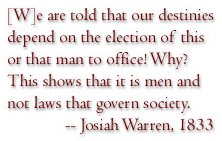
We are told that are destinies depend on the election of this or that man to office! Why? This shows that it is men and not laws that govern society. - Josiah Warren, 1833Admittedly the contention that all politicians are corrupt is a simplistic one. However, even the most honest and idealistic politician can be simply misguided. Whether the problem is dishonesty or lack of knowledge, it remains that there is no coherent and reliable basis for determining whether or not a given candidate is the “right” one.

Of course all of this assumes—unrealistically—that “your candidate” would even be able to effect his or her entire platform while in office.

7. Lack of Legitimacy

Engaging in the process of registering and voting is an implicit acceptance of its legitimacy for effecting social change (hopefully by now you’re starting to question such a belief!). I submit that this acceptance precludes complaint about both the outcome and any effects of the outcome — regardless of who wins. By participating in the system, you are tacitly accepting the rules of the game. If your candidate wins, would it not be rude of you to say, “nyah nyah!” to the losers? By the same token, aren’t you a sore loser if you whine about what the winner does?

A simple example (hat tip to Marc Victor) may serve to illustrate my point. Imagine that you are with a group of friends at a restaurant, eating dinner. The meal is almost over. However, the night is still young and you all are enjoying each other's company and would like to continue. Some of the party suggest going to get coffee, while others would like to go get ice cream. As there is not enough time to do both, everyone agrees to decide via a vote. If the ice cream contingent wins, is it then good manners for the coffee contingent to make a stink about the outcome?

In other words, as Andrew Galambos once said, “If you vote, don’t complain.”

8. Coercion

As I hope I made clear in reason #7 above, a vote is not only a vote for a particular candidate, but also a vote for the political process in general. Chairman Mao once said that government comes out of the barrel of a gun — meaning that the basic function of the political process is the coercion of others. Done in self-defense, this presents little difficulty. The state, however, long ago abandoned its role as a provider of justice and safety. Thus, the act of voting is an aggressive act, regardless of the insulating effects that the voting booth provides.

Can it really be said that coercion is an effective means of improving the world? Is your participation in the extortion and murder of others made okay because your only connection to these acts is punching a hole in a ballot? Is Hitler not guilty of genocide because he didn’t physically pour the Zyklon-B into the gas chambers? What, then, of the guilt of the voters who put him in office? Are they completely free of blame?

Join the ranks of those who can proudly proclaim, "Don't blame me! I didn't vote!"

More non-voting articles can be found here.

Saturday, May 13, 2006

John Burley's Advice vs. Astrology

“guru” and self-described “prosperity trainer” (about whom I have written extensively here), arguably most famous for his infomercial, used to offer an “intensely powerful” quarterly newsletter, called The Burley Chronicles. I believe a subscription cost around $99 a year. It’s apparently discontinued—I suspect for reasons that, in a moment, I’ll be making abundantly clear—but if you enter your mailing information at his web site then you’ll probably be sent your own complimentary issue, along with a bunch of other promotional materials.

In my copy, the 3rd issue from 2001, Burley welcomes readers with, “The learning, fun, and education continues.” Much of what follows is an “education” that isn’t worth 10 cents—let alone $99 a year! For example, in the same article, Burley says:

The cause of the depth of the current US slowdown (read ‘recession’), may be debated, but there is now general consensus regarding the timing and likelihood of economic recovery. Everybody agrees that they have absolutely no idea!

Everyone is searching for better profits and economic news. Are they looking in the right places? As a Level Five investor, where do we look for increased returns on our investments?

As I often say, it is not really important where you look for your investments. It is more important how you look! [emphasis original]

Looking at investing with the lateral thinking mind of the Level Five investor is the key to recognizing the limitless opportunities that exist in any market—and particularly in a recession market—for double digit and higher returns.
I read this stuff and become physically ill. This is “investment advice” on a par with what you’d get out of your daily horoscope! To prove my point, below I have taken several of Burley’s nuggets of wisdom (or something) and randomly interspersed them with items I’ve pulled from daily horoscopes. I challenge you to tell them apart.

A
Learn to produce results without agreement from others. It’s a marvelous skill to have, and will be quite profitable. And once you get past the nervousness, you’ll be very strong.

B
Remember, all coins have two sides and both sides are shiny if polished properly and viewed from the proper perspectives! Awareness, Attitude and Action!

C
We are still playing our own game by our own rules and the playing field grows larger by the day.

D
Don't worry if what you try doesn't work. It's just as important to know what won't. It narrows down the seemingly endless possibilities.

E
There are so many opportunities around these days that you might actually have to flip a coin to help you decide which one to pursue first.

F
Invest in an area that you have long been curious about. Get some of those old questions answered and you'll sleep better at night.

G
Remind people to look at the facts if they're getting emotional.

H
The sentiment of abundance that has driven growth over the last decade has taken on the scent of scarcity. This is when the astute and prepared rise above the naysaying rabble.

I
The workload is intense and the objective is muddled. Before you knock yourself out, find out what needs to be done and what doesn't. Your efforts will be appreciated.

I’ll reveal the answer in the comments at some point in the future. In the mean time, feel free to offer up your own guesses.

Wednesday, May 10, 2006

What is this blog about?

Recently, it seems this blog has had a rather narrow focus. I'll admit that I have been slathering quite a bit of attention on (and though he certainly doesn't deserve it, I do still have 2 or 3 more Burley posts planned). Honestly, though, I have no intention of adding Die Eigenheit to the cacophony of and blogs out there. I mean, what the hell do I know?

So, you see, I have always felt that if this blog's theme is anything at all (aside from its autobiographical nature), then it would have to be .

As a die-hard , I take belief very seriously. I often find myself consumed by doubts - sometimes to the point of experiencing a profound (and very disturbing) . Of late - as you've seen if you're one of the 4 people who reads this blog regularly - this tendency to question obsessively has manifested in my exploration of the the wacky belief that there are actually "secrets" that "the rich" keep hidden from the hoi polloi. This has meant a focus on , since, of the countless people spouting such nonsense, he's the one I am most familiar with. I will, soon, run out of things to say about that, though, at which point I'll have to move on to other things.

Al Swearengen once said, "If you want to see God laugh, tell him your plans," so I won't bore you with the specifics of mine. But if you were beginning to worry that I might never shut up about Burley this and Burley that, you can rest assured that even I will have had my fill of him before long.

Tuesday, May 09, 2006

Carnival of Personal Finance

I have been a little remiss in not mentioning earlier that my interview question post was recently included in the 47th Carnival of Personal Finance.

I'm not ashamed to admit that I submitted it in the hopes of getting some interesting comments, and I was happy to see that traffic to my blog did increase significantly. Though, I guess not-so-surprisingly, almost all of the carnival-generated visits took a quick look at the interview post and then left. Oh well...

Saturday, May 06, 2006

The Housing Bubble

I just put up a post about the over at The Lippard Blog, both because I've been feeling bad that I haven't put anything up over there in a long time and because it seemed like a better location for the topic, anyway, since Jim has several bubble-related items of his own there.

Enjoy!

Friday, May 05, 2006

The Scariest Job Interview Question

So, you're being interviewed for a job and feel like it's going pretty well. Seemingly out of nowhere, the interviewer hits you with, "What kind of salary were you looking for?"

As anyone familiar with negotiating tactics knows, the first person to mention a number is the loser. The above question forces the issue and, of course, is designed to get the job-seeker to reveal his highest price. Once it's out there, the employer need never mention that they were prepared to offer more. On the other hand, if the number quoted is unrealistically high or well above expectations, the employer may decide against making an offer at all.

How does one get around this - especially in this situation, when you're staring at your interviewer, who is sitting there expecting, any moment now, to hear words come out of your mouth?

I have heard that a good dodge is something like, "I am prepared to accept whatever you would normally offer someone with my skills in this position." Then, when they follow up with something along the lines of "What were you expecting?" you can quote them a wide range - maybe one you got from research on salary.com, or the like.

I'm interested, though, if you might know of any other clever ways to handle this tricky situation.

Thursday, May 04, 2006

John Burley's Dog and Pony Show

In my post talking about ’s book, I hypothesized that it’s probably as information-rich as his Boot Camp, even though it's $4980 cheaper. If you’ve read Burley’s promotional material for his Camp, you might object to my characterization, because, for example, on Day 2, the attendees are taken to downtown Phoenix to witness a trustee sale. Such an activity, however, is a complete waste of time, for several reasons.

In the first place, what is there to learn by attending a trustee’s sale? It’s just your standard auction, and who isn’t familiar with that? This is the 21st century. Who hasn’t been on eBay?

Next, as even Burley points out, these auctions are all cash. The typical Burley student doesn’t have any cash—or why would they be attending the Boot Camp? On top of that, most of the attendees are there to learn about Burley’s wrap technique, the point of which is to use as little cash as possible (otherwise your cash-on-cash returns evaporate). So, not only are Burley’s students unlikely to ever be capable of bidding in a trustee auction, they’re not likely ever to want to do so, either.

Something tells me that Burley also probably doesn’t mention a number of serious drawbacks to the trustee sale. It’s rare for a “distressed property” to even get to the auction, so the ones that do are likely to have a storied history. The owner has to have played ostrich—putting the mortgage several months into arrears (necessary before the foreclosure process can even begin). Then public notice of the auction has to happen at least 60 days prior. A lot can happen in those 5 to 6+ months. How many investors specializing in distressed properties do you think have spoken to the owner during that time (and still didn’t manage to put together a deal)? How much maintenance do you think the owner has been doing on the property? Do you think the owner is going to be happy to leave? If the house gets to auction then there’s a near certainty that it has a real problem—one that’s probably not going to be profitable for you to solve, even at “thirty to seventy cents on the dollar.”

Once bidding on the house starts, what do you think happens? The first thing is that the bank holding the primary mortgage bids the amount of the balance owed—to ensure they get paid. If that’s 90% of the market value of the home, then where’s your money going to be made? And what if it’s you who ends up making the winning bid? The question that should immediately come to mind is, “What do all these other people know that I don’t?” The Winner’s Curse isn’t just some witch doctor’s superstition.

Given all this, Boot Camp attendees are, in reality, paying about $500 for little more than a dog and pony show. John Burley, on the other hand, is laughing all the way to the bank.

Wednesday, May 03, 2006

The Burleyists – Robyn Grinter

I am confident that not a day goes by during which John Burley doesn’t fall to his knees, clasp his hands together, look reverently toward the sky, and thank his Lord and Savior for Robyn Grinter.

Robyn, you see, is proof positive that anyone can do it, as long as you have faith and believe in yourself! Robyn is the hero and the inspiration for all the ChavaRicas out there, who think, “If she can do it, then I can, too! What do all you psychobabbling naysayers know? Success leaves clues! Plus, Robyn obviously cares about my success, so I believe her!”

Robyn says:

You see 95% on success in investing is in your head it is as simple as “if you think you can’t you are right” or “if you think you can you are right” either way you are right so just think the right thoughts. [sic]
Robyn knows of what she speaks, since she’s done 220 real estate deals since 2001. So, clearly, if you fail as a property investor it’s 95% certain that your failure was simply the result of the weakness of your convictions.

Burley couldn’t have asked for a better Burleyist.

Tuesday, May 02, 2006

Yikes!

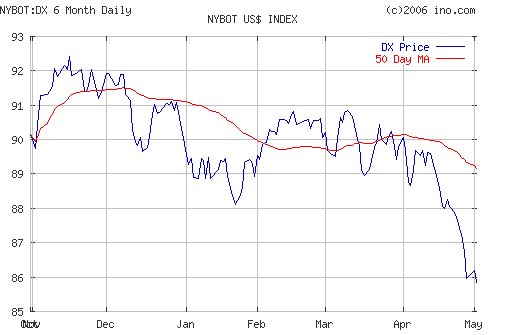
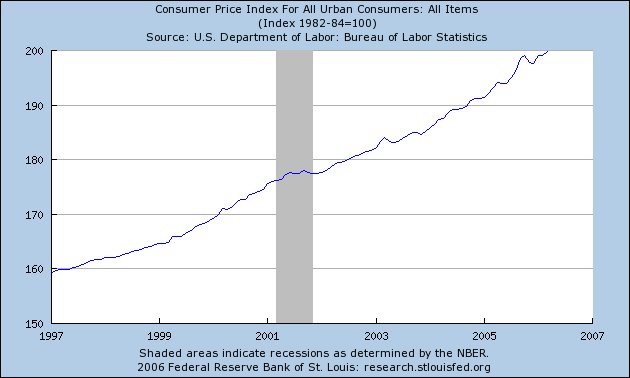
These charts aren't very much fun.


At times like these I wish I was being paid in gold.

Charts courtesy mises.org.